9.8
HearingReview Independent's Verdict
7 Reasons Audexa Is the Rechargeable Hearing Aid People Who Already Said No to $5,000 Are Actually Using
Every hearing device category promises clearer conversations. Most charge you for a building and a salesman to deliver them. Here's what happens when you remove both.
Quick Summary
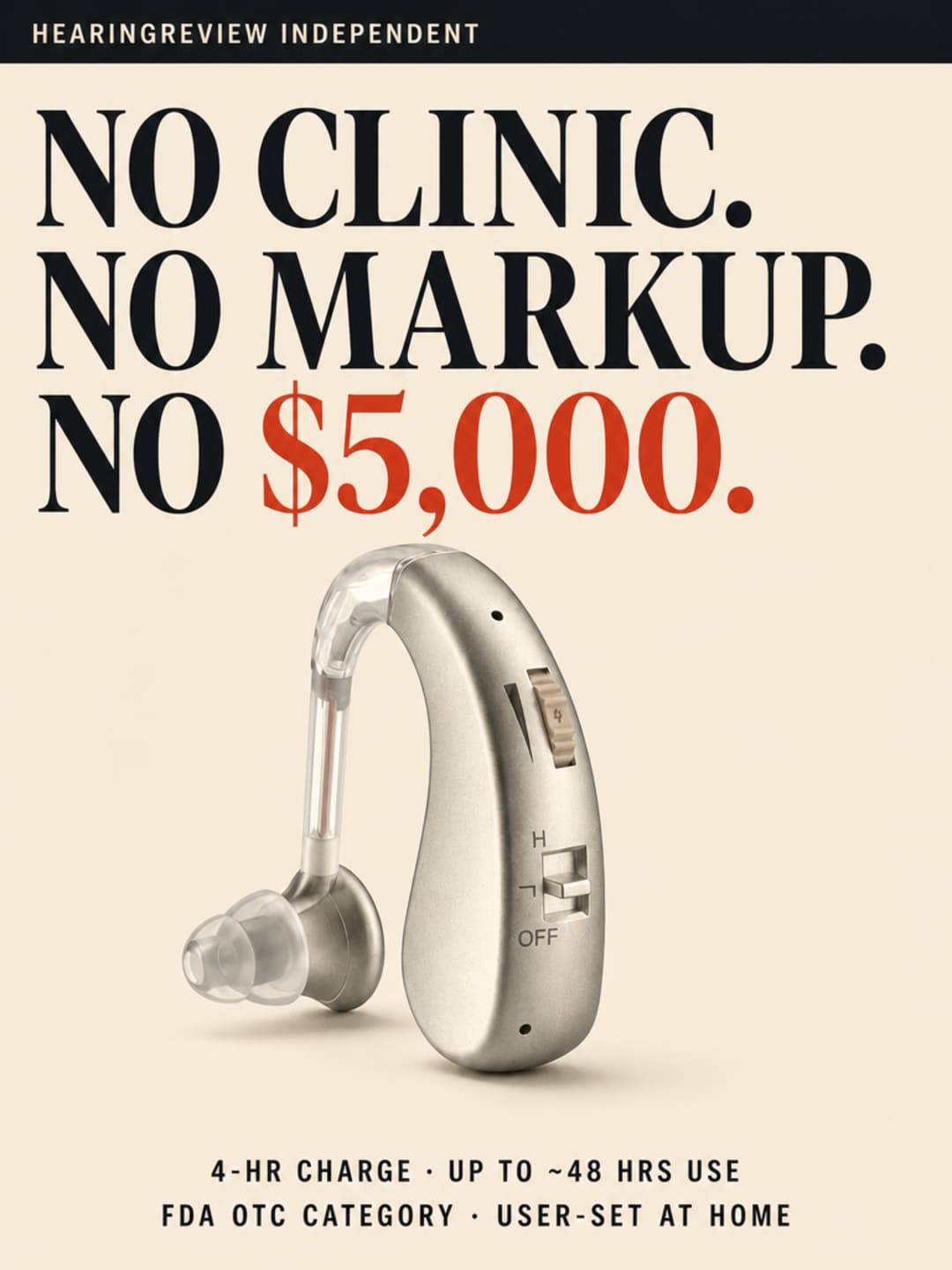
Audexa is a rechargeable, behind-the-ear hearing device set up by the user at home — no prescription, no appointment, no clinic markup. It is built for adults who understand conversations are harder to follow than they used to be and have either been quoted thousands at a clinic or burned through cheap amplifiers that amplified the wrong things. The FDA has permitted non-prescription hearing aids for adults since October 2022. The case for Audexa is simple: the electronics were never the expensive part. The building was.
You've already weighed the options. The clinic quote sat on the counter for a week before you pushed it back across the desk. Maybe the $40 pair from Amazon amplified every dish clatter in the kitchen and fell out by noon. You're not starting from zero — you're trying to make a better second choice, on evidence, without risking what the first two choices already cost you. That's the situation this advertorial is written for. The enemy here is not your hearing. It's a category that built its pricing around real-estate overhead and then told you the overhead was audiological precision.
What Changes for You
1
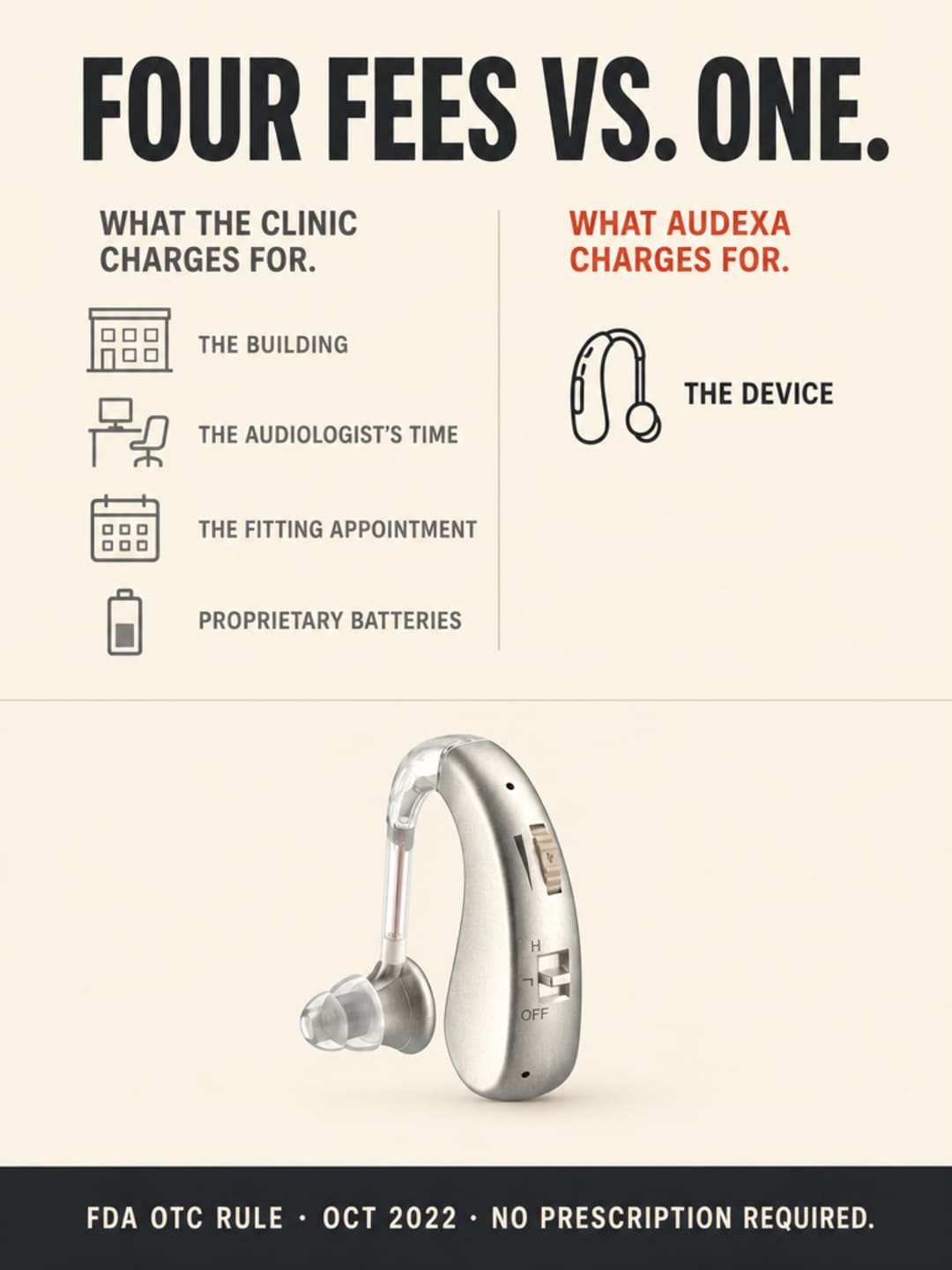
The Clinic Charged You for the Building. Audexa Doesn't.
In October 2022, the FDA created a non-prescription hearing aid category for adults 18 and older with self-perceived mild-to-moderate hearing difficulty. No audiologist required. No fitting appointment. No prescription. That rule did not change the electronics inside hearing devices. It changed who is permitted to sell them to you without a clinical intermediary — and what that intermediary's fee was adding to your invoice.
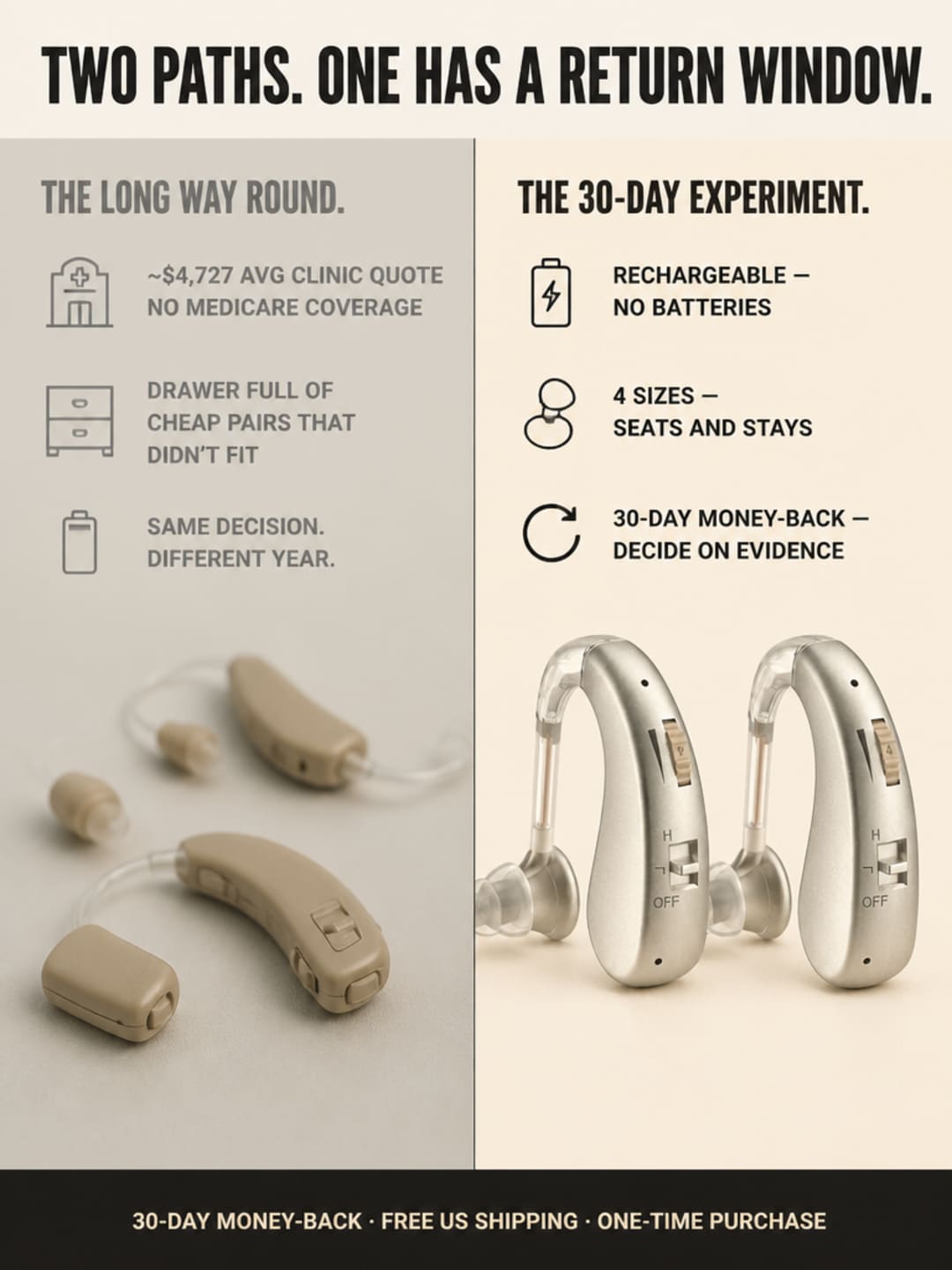
Prescription hearing aids average ~$4,727 per pair without insurance, according to HearingTracker's 2025 analysis of 879 retail quotes. Standard Medicare Parts A and B do not cover hearing aids — not the fitting, not the devices, not the batteries. If you paid out of pocket last time, the system will ask you to do exactly the same thing next time. Nothing in the clinic changed. Something in the law did.
Audexa is a behind-the-ear rechargeable hearing device sold direct, without a clinical intermediary in the chain, at a fraction of what a prescription clinic charges. The electronics are in the device. The building is not in the price.
2
Ten Years Is a Long Time to Wait for a Decision.
Approximately 37.5 million US adults — around 15% of the population — report some degree of trouble hearing. Only about 1 in 4 of those who could benefit from hearing aids actually uses them. The gap is not ignorance. It is the $4,727 quote on the counter, the drawer full of things that didn't work, and the slow arithmetic of deciding whether the next purchase will be different.
That arithmetic has a cost too — measured in conversations followed at half-volume, in people who stopped saying things twice, in dinner tables where you tracked mouths instead of jokes. The 30-day money-back window on Audexa is not a sales tactic. It is the verification period. Try it at the dinner table. Decide on evidence, not on another quote.
1 in 4who could benefit actually uses hearing aids (NIDCD/HLAA)
3
The Person Audexa Was Built For Already Knows What $5,000 Gets You.
The buyer who finds Audexa useful is not someone who has never thought about this. They have thought about it — usually for longer than they'd admit. They know what the clinic costs. They know what the cheap pair from the internet delivered. They are looking for the thing in the middle: built to fit, built to stay charged, and built so that if it doesn't work, returning it doesn't require a lawyer.
That is the exact problem Audexa was designed to solve. Not clinical-grade amplification. Honest amplification, at a price that doesn't require a second mortgage, with a return policy that doesn't punish you for trying.

Why It Works
4
Rechargeable. Four Sizes. No Batteries to Chase.
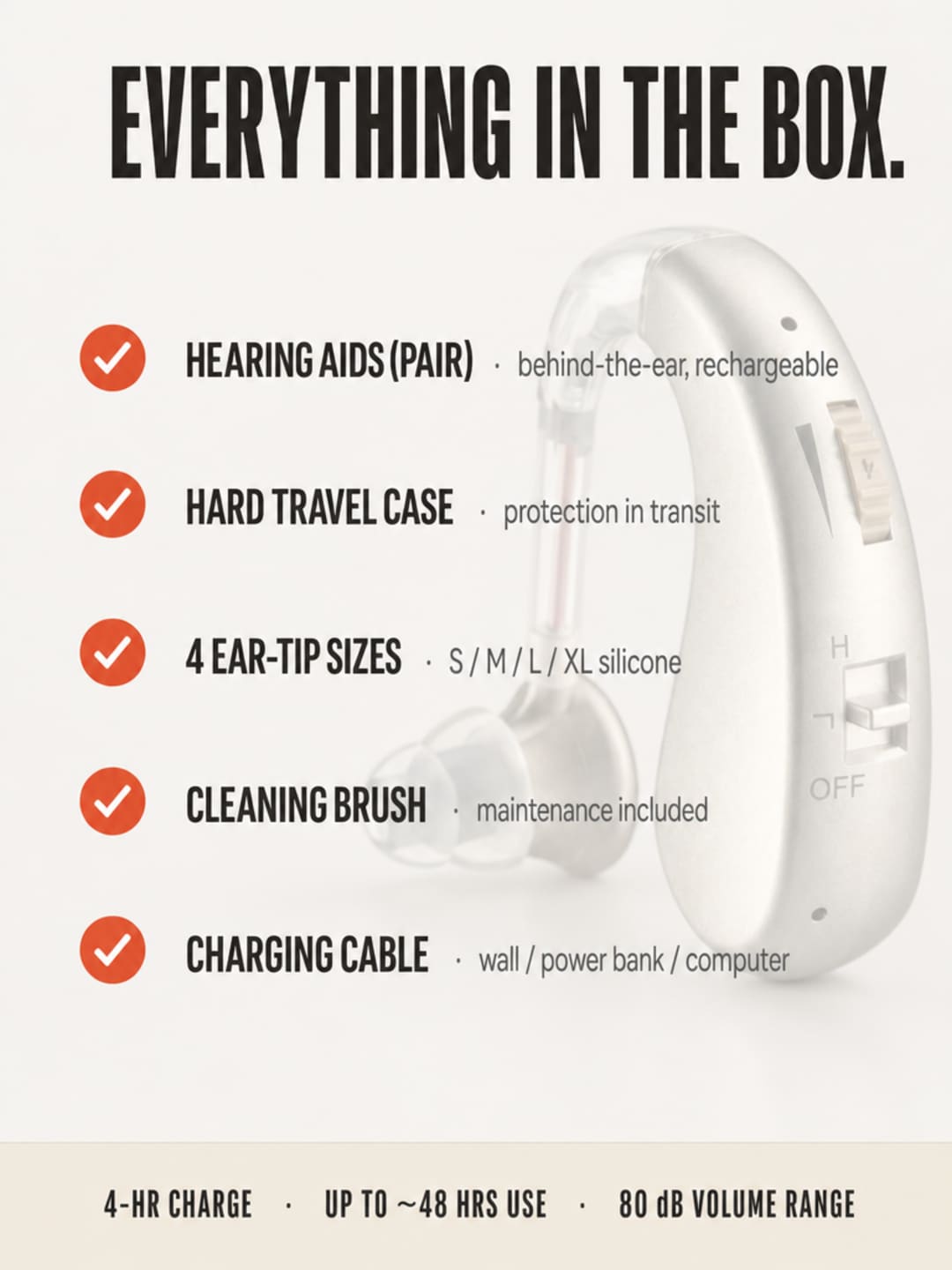
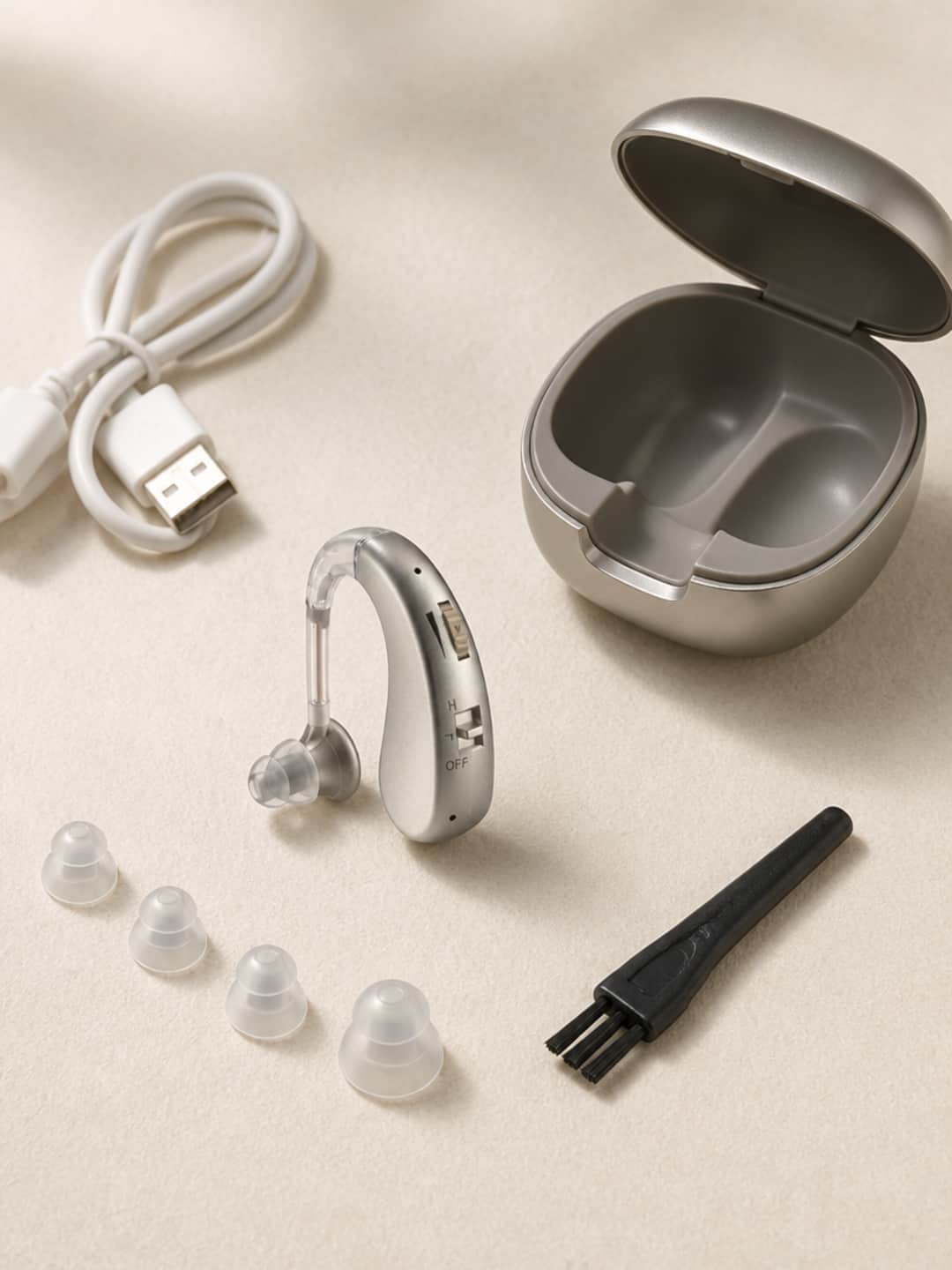
Every verified item in the box:
Audexa hearing aids — one pair, behind-the-ear
Hard travel case — protection in transit and at home
Four silicone ear-tip sizes (S / M / L / XL) — fit range, so the device seats and stays
Cleaning brush — maintenance included
USB charging cable — charges via wall outlet, power bank, or computer
The four silicone ear-tip sizes are the functional detail that matters most in this box. Cheap amplifiers fall out or whistle because the dome doesn't seat against the canal. When a dome doesn't seal, the amplified sound leaks back into the microphone and creates the feedback loop — the squeal that makes the device unwearable. The four-size system is not a selling point: it is the mechanism by which the device stays in and the feedback loop is interrupted.
Charging: a 4-hour charge delivers up to approximately 48 hours of use. No proprietary batteries. No pharmacy run every four days. No "did I pack the spares?" Charge overnight, hear all day. Volume is adjustable up to 80 dB via the top-mounted dial. The on/off switch is front-mounted — large enough to find without reading glasses.
5
The Difference Is Not Sound Quality. It's What You're Paying For.
The clinic fee is mostly overhead — the building, the staff, the fitting appointment, the audiologist's time, the proprietary software for adjustments. The electronics at prescription tier are better-engineered. That is true. But for self-perceived mild-to-moderate difficulty following speech — the OTC category the FDA defined in 2022 — the clinical apparatus is not always the variable that changes your dinner-table experience. The fit is. The charge life is. Whether you can send it back without a $21 return-kit fee is.
The comparison below maps the full picture: prescription clinic, cheap online amplifier, and Audexa, row by row, on the features that actually determine whether a device ends up in your ear or in a drawer.
~$4,727avg prescription pair without insurance (HearingTracker 2025, n=879)

6
Behind-the-Ear. Sits With Glasses. Doesn't Announce Itself.
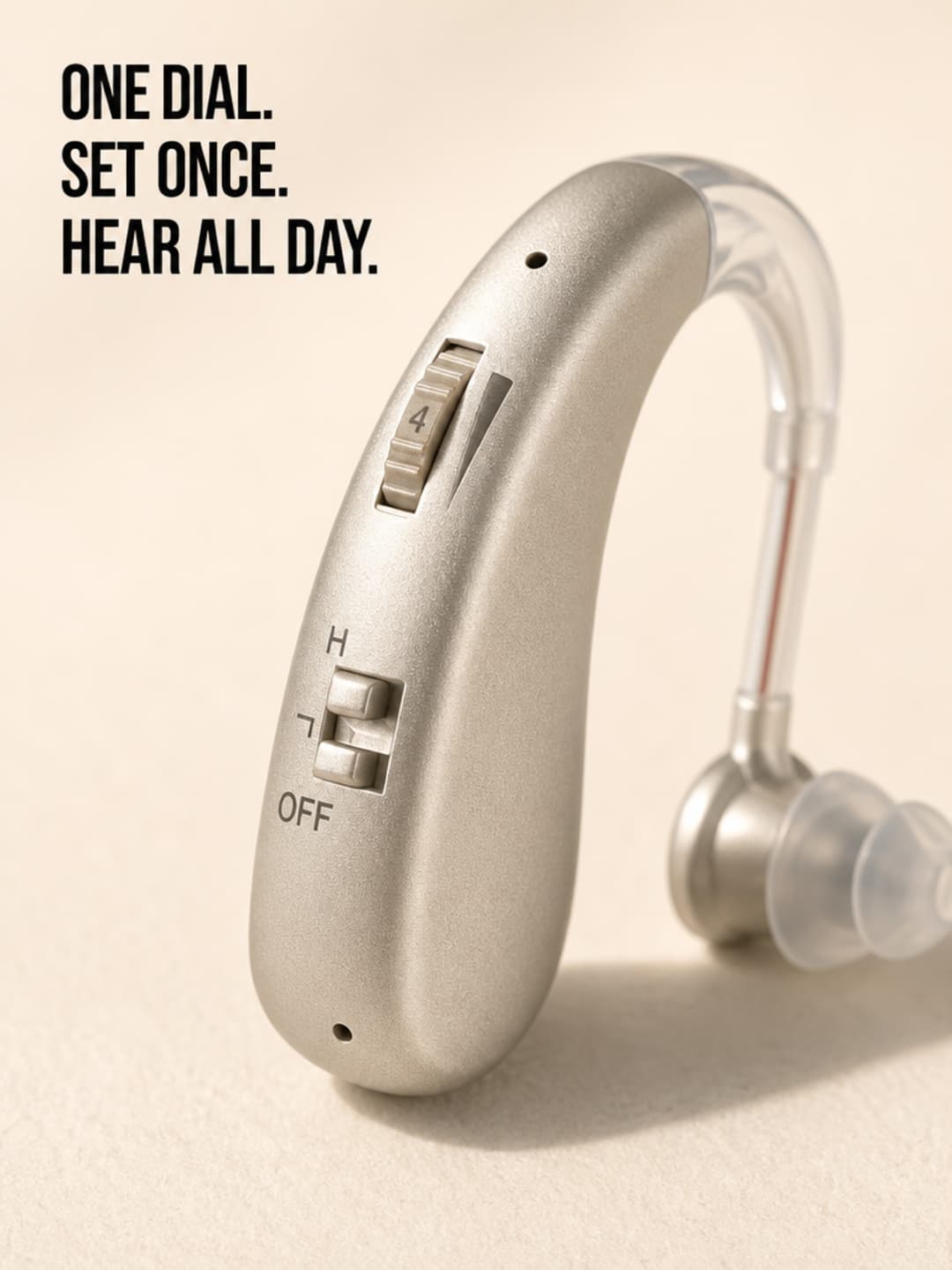
Audexa is a behind-the-ear device — the receiver tube routes from the unit behind the ear to the dome seated in the canal. The BTE form sits flat against the head and is designed to coexist with glasses frames, not compete with them.
The unit itself is silver-champagne. Small. The receiver tube is thin. From any conversational distance — across a dinner table, across a counter — it reads as barely there. Not invisible. But not the brown-worm-on-the-ear that the previous generation of cheap devices produced.
The top-mounted H/OFF dial is the entire interface. Turn it up or down — that is the adjustment. No app, no Bluetooth pairing screen, no firmware update. For someone whose hands are not as steady as they were, or who does not want to manage a hearing device like a smartphone, this is a feature, not a limitation.
80 dBvolume range — single dial, no app required
Why Now
7
Another Wrong Choice Has a Cost. The Guarantee Is There So You Don't Have to Take Our Word for It.
Here is the honest accounting of where people in this situation tend to end up:
The clinic route costs ~$4,727 on average without insurance. Standard Medicare won't pay for it. If you've already been through that once, the replacement pair costs the same. The system hasn't changed.
The cheap-amplifier route costs less in dollars and more in dinner tables. Real customer accounts document amplifiers that picked up "every dish clatter," amplified "even my heartbeat," and devices that "would not stay in — fell on the floor." The drawer fills up. Nothing gets returned because the return window expired, or because the return kit costs money, or because the address was an ocean away.
The honest admission: Audexa is not a clinical-grade prescription device. It will not perform identically to a $4,727 audiologist-fitted pair for someone with severe or asymmetric loss. If that describes your situation, the clinic is the right answer for you.
What Audexa does is amplify and clarify everyday speech for adults with self-perceived mild-to-moderate difficulty — at a price that makes a 30-day trial genuinely low-stakes. Not "risk-free" as a marketing claim. Risk-free in the literal sense: the money-back window is long enough to take it to one family dinner, one phone call, one afternoon watching the news, and decide on actual evidence rather than another guess.
The cost of getting this wrong again is not just the dollars. It is the next year of conversations at half-volume. The 30-day window exists so you don't have to trust this page to know whether it works. You try it. You decide.
How Audexa Compares
Feature
Prescription Clinic / Cheap Amplifier
Audexa Hearing Aids™ Our Pick
Price per pair
Prescription clinic: ~$4,727 avg without insurance (HearingTracker 2025, n=879) · Cheap amplifier: $20–$100
See the next page — no price is buried here
Medicare coverage
Standard Parts A/B: none for hearing aids, fittings, or batteries
Not applicable — direct purchase, no clinical intermediary
Power source
Prescription: proprietary batteries replaced every few days · Cheap: disposable or short-life, no recharging
Rechargeable — 4-hr charge → up to ~48-hr use
Fit system
Prescription: custom audiologist-fitted · Cheap: one-size — falls out, no seal
4 silicone ear-tip sizes included (S / M / L / XL)
Prescription required
Prescription clinic: yes — appointment gated · Cheap: no
No — user-adjustable at home (FDA OTC rule, Oct 2022)
Return policy
Clinic: varies, typically limited post-fitting · Cheap: often no return, or fee-based return kit
30-day money-back
What amplifies
Cheap: everything equally — wind, dishes, heartbeat · Prescription: clinically tuned but gated behind a $4,727 quote
Volume adjustable up to 80 dB; 4-size fit seats the dome so amplified sound goes in, not back into the mic
~$4,727
avg prescription pair without insurance (HearingTracker 2025, n=879)
Oct 2022
FDA OTC Hearing Aid rule — non-prescription sale legal for adults 18+
37.5M
US adults report trouble hearing; only ~1 in 4 who could benefit uses aids (NIDCD/HLAA)
~48 hrs
use per 4-hr charge; volume adjustable up to 80 dB
🛡️
30 Days to Decide — On Evidence, Not On Faith
The 30-day money-back window is the verification period. Take Audexa to a dinner table. Use it on a phone call. Wear it through an afternoon with the television. If it doesn't make speech easier to follow in situations where that matters to you, the return window is there. That is the entire promise. Not "love it or your money back" as a phrase — as a policy.
No subscription. No card stored after your order ships. No hidden charges. One purchase.
Is Audexa Hearing Aids™ Right For You?
Perfect for you if
- You're an adult 60+ with self-perceived mild-to-moderate difficulty following conversations — especially in group settings, on the phone, or with soft-voiced speakers
- You've walked out of a clinic after a quote of $4,000 or more and want an honest alternative, not a cheap imitation
- You're a spouse, adult child, or caregiver purchasing a low-stakes, returnable first step for a family member who refuses to spend thousands on a prescription pair
- Your last cheap amplifier whistled, fell out, or amplified everything except speech — and you want one built with four fit sizes
Not for you if
- You have severe, profound, or asymmetric loss that a clinical evaluation has identified as requiring medical-grade amplification — this device operates within the FDA's OTC mild-to-moderate category
- You need audiologist-programmed frequency adjustment, smartphone-app connectivity, or clinical-fitting precision — Audexa is a single-dial BTE device; its simplicity is its design
- You're seeking tinnitus management, a medical diagnosis, or treatment for a diagnosed hearing condition — Audexa is not a medical device and does not treat, cure, or prevent any condition
HearingReview Independent's Verdict
9.8/ 10
Audexa lands where the category needed something to land: honest about what it is, priced at a point where the 30-day trial is a genuine experiment rather than a gamble, and built around the two physical details — rechargeable power and a four-size fit system — that determine whether a hearing device stays in your ear or ends up in a drawer. For adults navigating the gap between a $4,727 clinic quote and a $40 Amazon amplifier that amplified the dishwasher, this is the device that closes that gap without requiring you to trust anyone's word for it. Try it at the dinner table. The evidence is either there or it isn't.
What's on the Next Page
Audexa Hearing Aids™
What You'll Find When You Click Through
The complete contents of the box — the pair, the case, the four ear-tip sizes, the cleaning brush, the charging cable — listed and photographed. The exact specs: charge time, use time per charge, volume range, form factor. The return policy in plain language — what "30-day money-back" actually means as a process, not a phrase. And the purchase page — where the price is stated clearly, with no subscription and no charges after your order ships. You can read all of it before you decide. Nothing is hidden behind a timer or a dwindling stock count. Not available on Amazon or eBay.
✓ Free US shipping
✓ 30-day money-back
✓ No subscription
✓ No hidden charges after your order ships
Still Not Sure?
Is this a real hearing aid or just an amplifier?
Audexa is an FDA Over-the-Counter (OTC) hearing device — a category created by the FDA in October 2022 for adults 18+ with self-perceived mild-to-moderate hearing difficulty. It is not a prescription medical hearing aid and does not require an audiologist or a fitting appointment. It is a legal, non-prescription hearing device that amplifies and makes speech easier to follow. Whether it is "enough" depends on your specific situation — which is exactly what the 30-day window is for.
Will it whistle or squeal the way my last cheap pair did?
Whistling in hearing devices is almost always a fit problem: when the dome doesn't seal against the ear canal, amplified sound leaks back into the microphone and creates a feedback loop. Audexa includes four silicone ear-tip sizes (S / M / L / XL) specifically so you can find the size that seats and seals in your ear. We will not claim "zero whistling guaranteed" — that claim depends on fit, which depends on the individual ear. What we can say is that the four-size system is the mechanism designed to address the problem.
What does the return actually involve — is there a restocking fee or a return-kit charge?
The offer is 30-day money-back with free US shipping. The full details of the return process — including any steps required — are on the product page. We recommend reading the return terms before purchasing. The category has a documented history of return traps: surprise kit fees, international return addresses, and narrow windows. Check the specifics on the next page before you commit.
Does Medicare cover this?
Standard Medicare Parts A and B do not cover hearing aids — not the devices, not the fitting, not the batteries. This is a category-wide fact, not a specific policy on Audexa. Some Medicare Advantage plans offer hearing benefits — check your specific plan. Audexa is a one-time purchase with no subscription, no recurring charge, and no hidden fees after your order ships.
HearingReview Independent is a publication operated by the seller of Audexa Hearing Aids™, and purchases made through the links on this page generate revenue for it. This page is a promotional advertorial — it was written by the company selling the product reviewed. It is not independent journalism, and it is not an editorial review produced by a third party. Every factual claim on this page is sourced to its origin in the copy; every claim without a source is framed qualitatively. This page does not represent the views of any third-party publication, institution, or government agency. Audexa is not a medical device and is not intended to diagnose, treat, cure, or prevent any medical condition, including hearing loss, tinnitus, dementia, or cognitive decline. The FDA OTC Hearing Aid rule permits non-prescription sale of hearing devices to adults 18+ for self-perceived mild-to-moderate hearing difficulty; it does not constitute an endorsement of any specific product. Individual results will vary. This page is for informational purposes only and does not constitute medical advice; consult a qualified healthcare professional regarding any hearing health concerns.