7 Reasons Audexa Keeps Beating Every Cheap Hearing Aid You've Already Tried
Every budget hearing device you've compared promised clear speech. Most shipped with one dome size — and sealed nothing. Here's the one that actually fits.
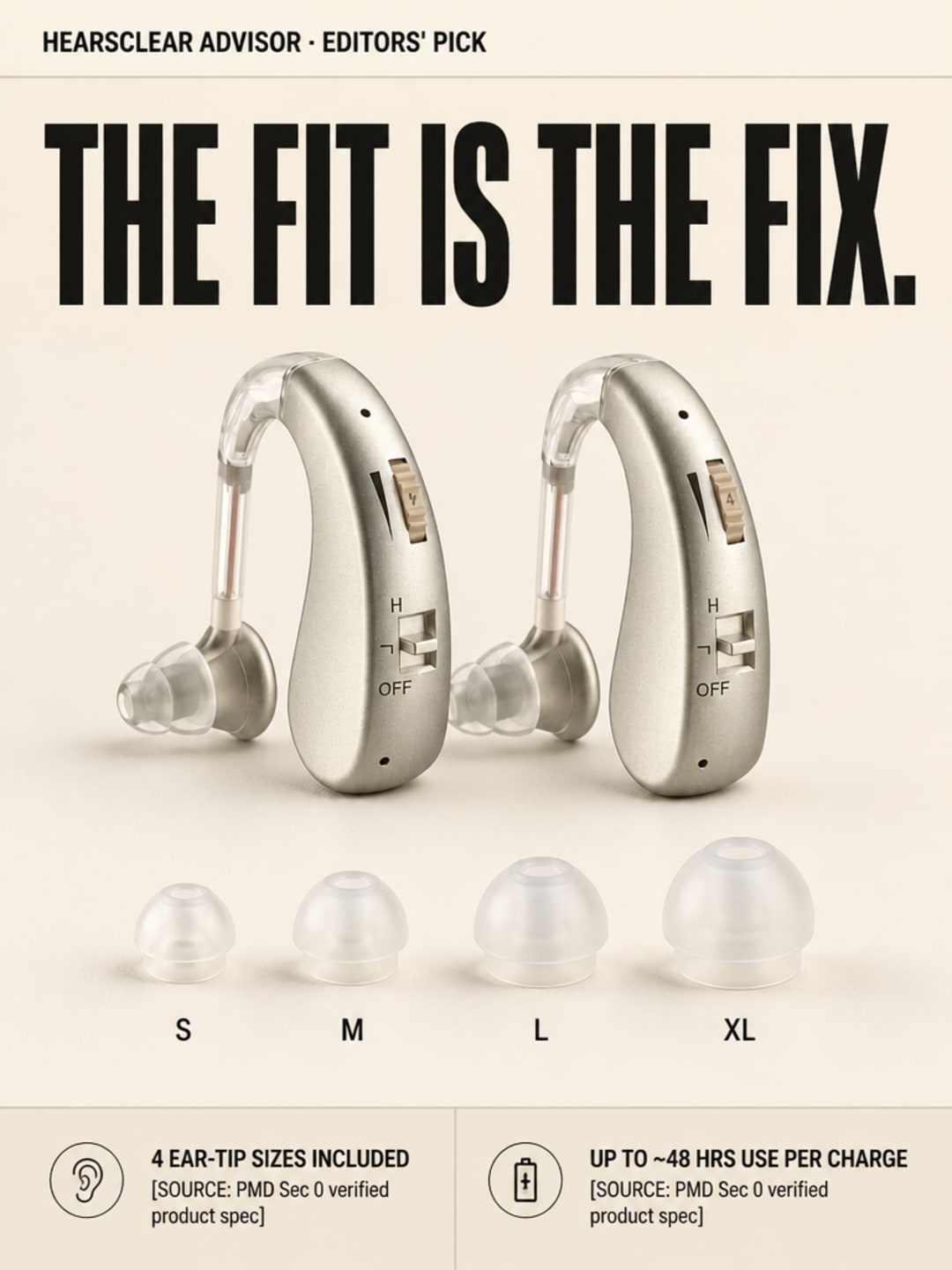
You're not reading this because you haven't heard of cheap hearing aids. You've heard of them. You may own one — or the remains of one, in a drawer somewhere, next to the cleaning brush you used twice. The comparison you're making now is not cheap vs. expensive. It's cheap that works vs. cheap that doesn't. One category feature separates those two things, and most brands have never bothered to include it.
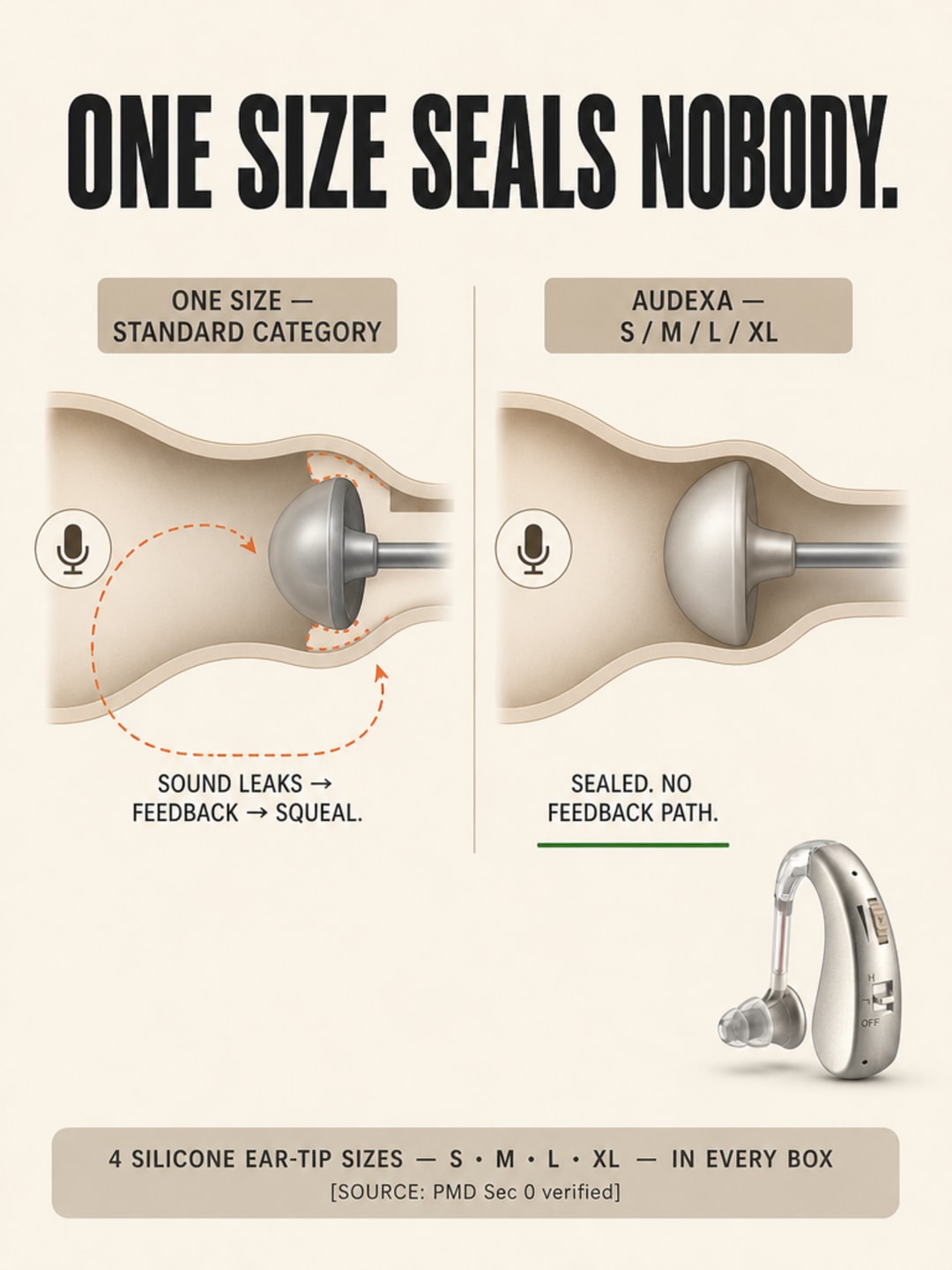
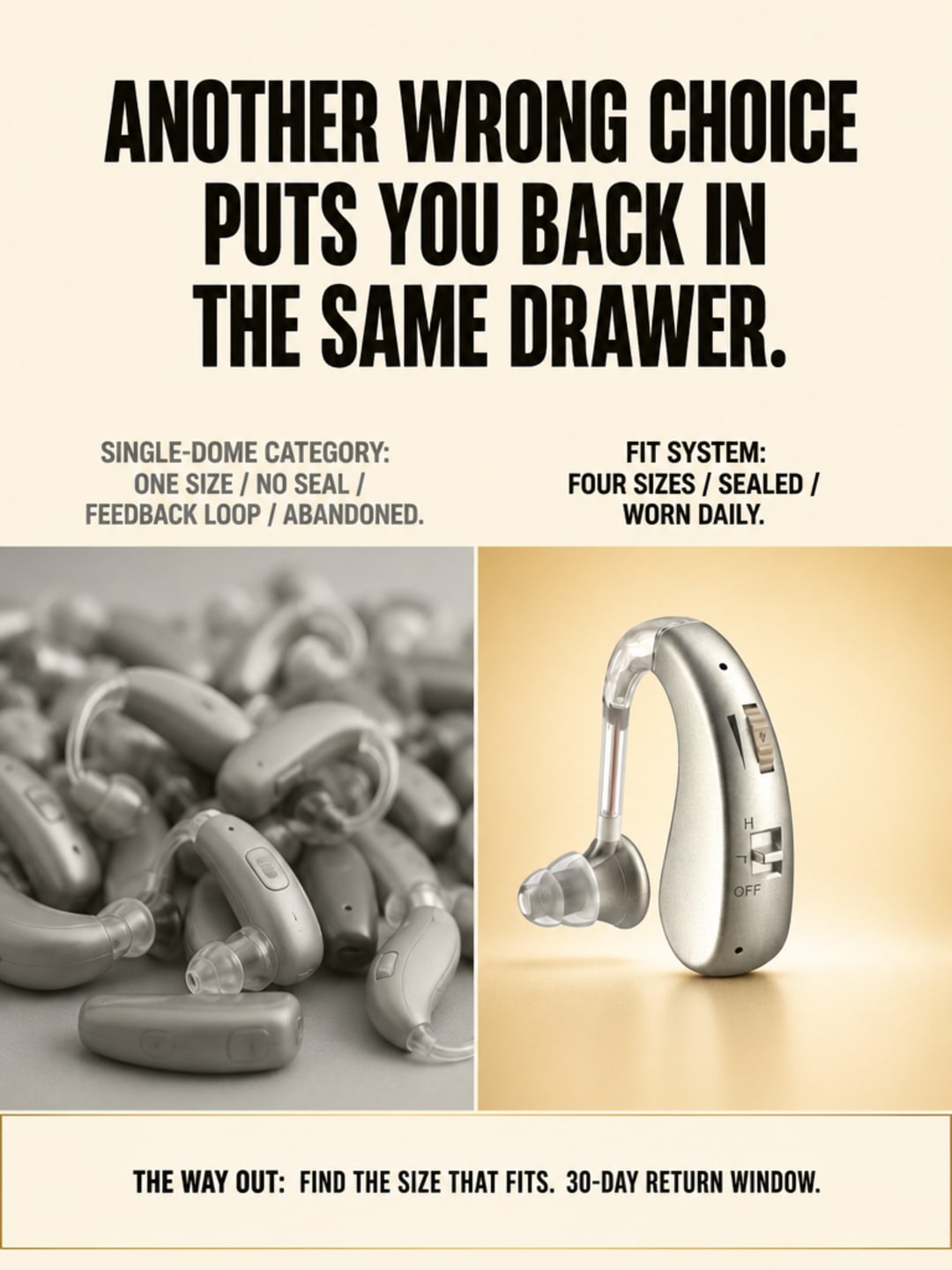
Every budget hearing device you've weighed uses the same manufacturing shortcut: one dome size, shipped to every wearer. Human ear canals vary — width, depth, angle. A dome that doesn't match your canal doesn't seal. When it doesn't seal, amplified sound leaks out of the canal, re-enters the microphone, gets amplified again, and the device squeals. That loop doesn't stop until you pull the device out.
Audexa includes four silicone ear-tip sizes — S, M, L, XL — in the box. You try each one. The size that seats without pressure is the size that seals. The sealed dome stops the feedback loop before it starts. The squeal is eliminated not by electronics, but by fit geometry.
That's the only differentiator that matters here — and it's the only one most of the category has never supplied.
This is not a theoretical problem. It has a paper trail.
"They whistle when anything comes close to the ear. It is impossible to converse on a telephone." — Amazon review, budget hearing amplifier category
"Big, brown and bulky… they would not stay in… fell on the floor." — ComplaintsBoard
"Everything was louder, I do mean everything… even my heartbeat." — ComplaintsBoard
These are not outliers. They are the consistent, multi-platform, multi-brand record of what happens when a single dome size is shipped to anatomically varied ear canals and the volume dial has no graduated middle. The device gets loud before it gets clear. It gaps before it seals. It falls out before it helps.
The correction isn't expensive. It's four sizes.
There is no break-in period for a properly sealing dome. When you insert the size that seats correctly in your canal — no pressure, no gap — the acoustic environment changes in the first minute of wear. Conversations that required leaning forward and cupping your hand to your ear become followable at a normal sitting distance. The dinner table becomes the dinner table again.
The rechargeable design helps here too: a 4-hour charge and up to approximately 48 hours of use means you are not rationing hours or fishing for a disposable battery at the wrong moment. You put it in in the morning. You wear it. You charge it when you sleep.

The landing page shows you the four ear-tip sizes and every component in the offer — before you commit to anything.
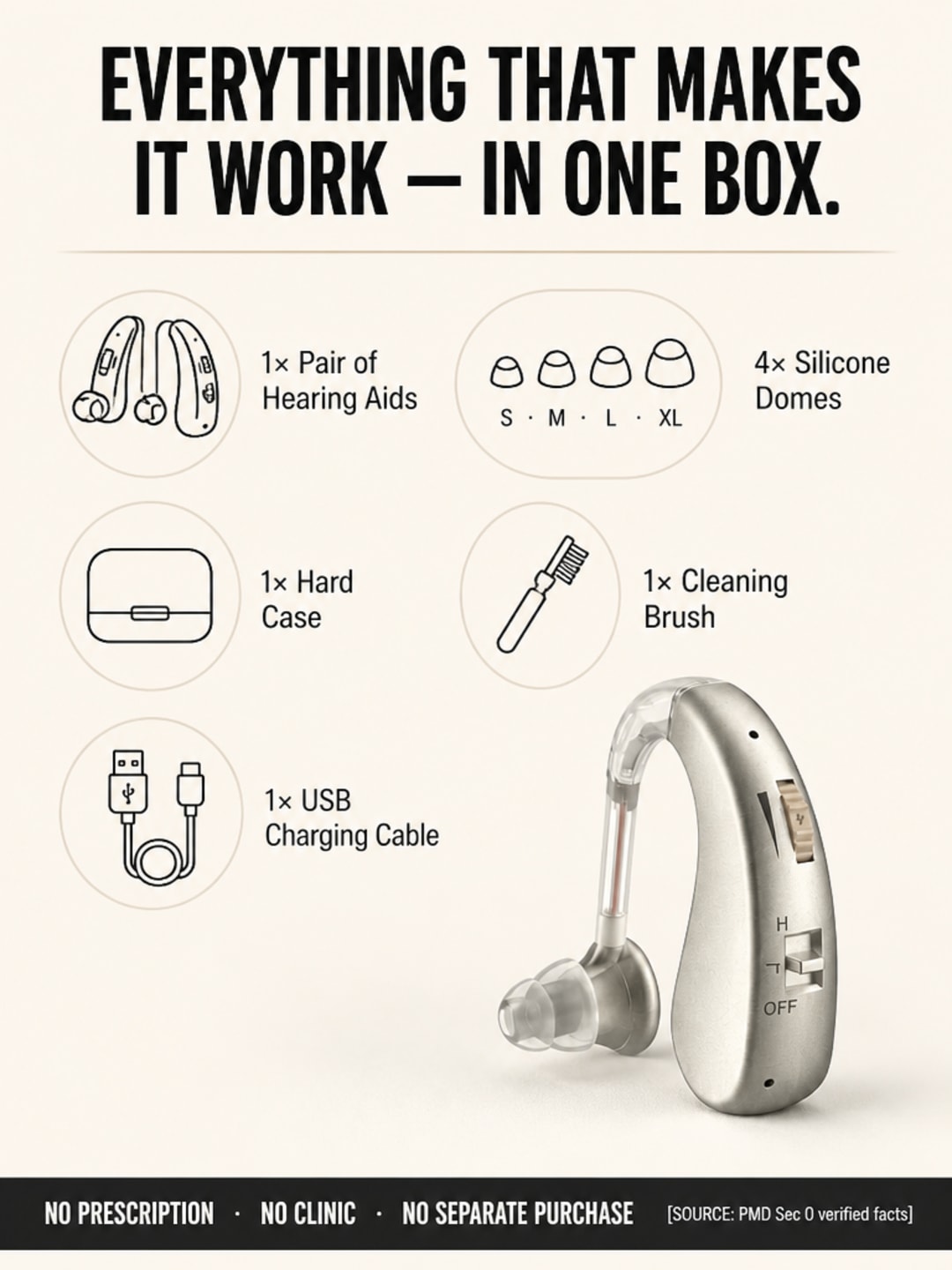
See What's Actually Inside Audexa — and the Full Fit-System Breakdown →There are no "starter kits" with the rest sold separately. There are no premium-tier upgrades. The Audexa pair ships with:
- Two hearing aids (a pair — left and right)
- Four silicone ear-tip sizes: S, M, L, XL
- Cleaning brush
- Charging cable (USB, compatible with wall, power bank, or computer)
The fit system is in the box. The cleaning brush is the one maintenance step the manual asks for. Nothing is missing that the device requires to work.
No prescription. No clinic visit. No audiologist appointment. The FDA Over-the-Counter Hearing Aid rule (effective October 17, 2022) legalised non-prescription sale to adults 18+ with self-perceived mild-to-moderate hearing difficulty. The appointment was always optional.
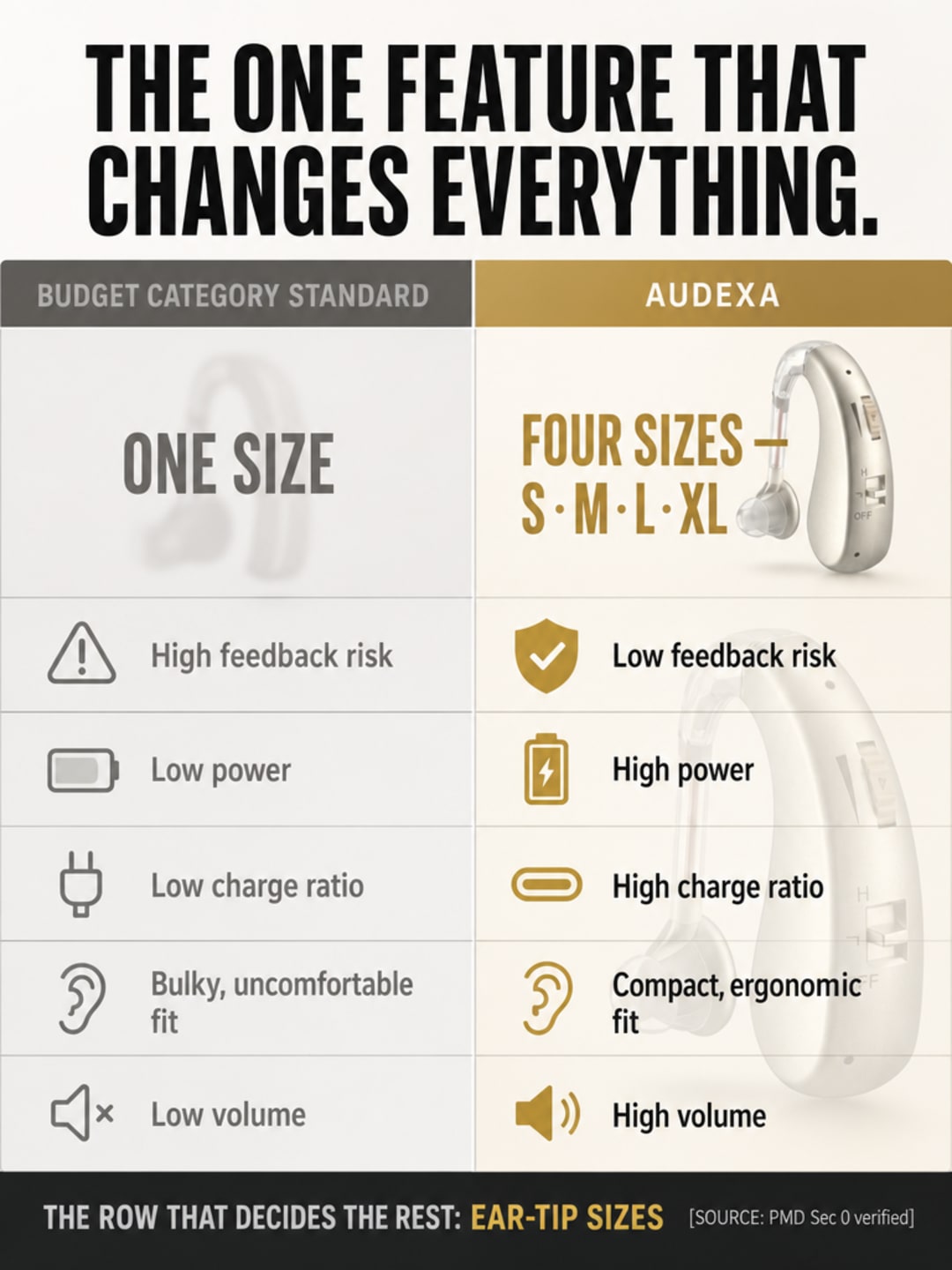
No claim here is "as good as a $5,000 aid." That comparison isn't what this page is making. The claim is narrower and more verifiable: Audexa includes four ear-tip sizes. Most of the budget category does not. Everything downstream of that decision — squeal, fit, abandonment — follows from it.
The comparison is on the table below. One row decides the rest.
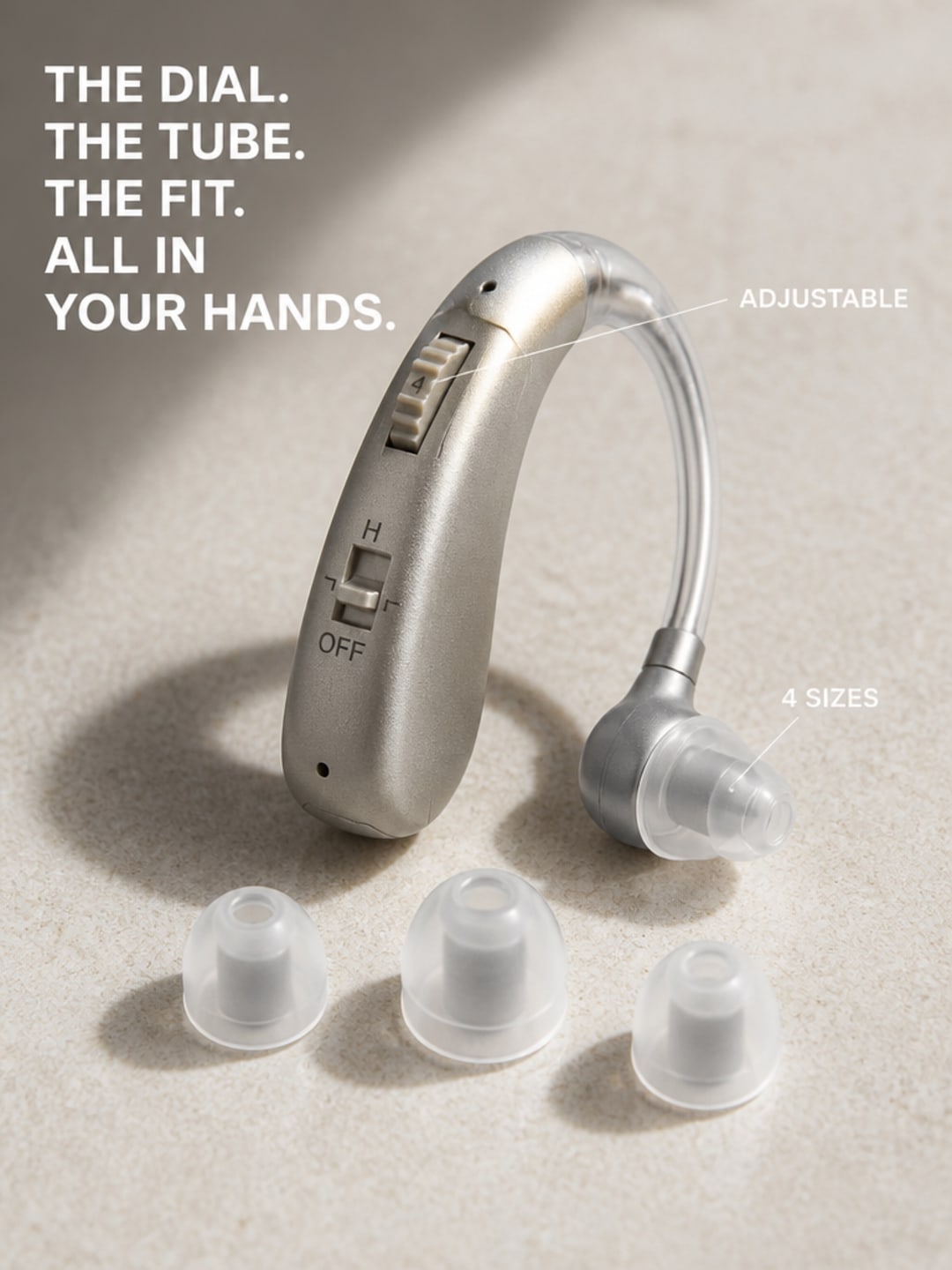
The device is behind-the-ear (BTE). The main body — housing the microphone, processor, and speaker — rests on the upper curve of the outer ear, the same place eyeglass arms rest. A thin receiver tube routes to the silicone dome seated in the ear canal. Because the primary weight is on the ear structure rather than the canal wall, the device stays without depending on dome pressure alone.
The volume dial sits on top of the main body. It is large enough to grip and turn without removing the device. Adjustment range runs up to 80 dB — not a fixed preset, not a lab average for a hypothetical wearer, but a range you set to the level that works in the room you're in.
The charging system is USB. Any USB port works — wall adapter, computer, portable power bank. A full charge takes approximately four hours. On a full charge, runtime extends up to approximately 48 hours.
The silicone ear-tip domes (S, M, L, XL) slip onto the receiver tube end. You start with M. If you feel pressure, go smaller. If you hear a squeal, try larger — a tighter seal stops the feedback path. The correct size takes a minute to find. It then stays.
That is the entire operating mechanism. Nothing requires a clinic visit to configure, because there is nothing that requires a clinic to configure.
The device in the drawer cost money. It may have cost thirty dollars. It may have cost a hundred. It squealed, or it fell out, or it amplified the refrigerator more convincingly than it amplified your wife. You stopped wearing it. The problem it was supposed to solve is still unsolved.
If you buy another device from the budget category without a fit system, the experiment repeats. The single-dome geometry is still there. The feedback path is still open. The probability of the same outcome is not reduced by the fact that this time the box looks different.
The prescription alternative costs more. The average US prescription hearing aid pair costs approximately $4,727 without insurance — and Medicare does not cover hearing aids as standard. That is not a framing trick. It is a sourced market fact from HearingTracker's 2025 survey of 879 respondents.
The honest admission: Audexa is not a clinical device. It does not come with an audiogram, a fitting session, or follow-up calibration. For mild-to-moderate self-perceived hearing difficulty — the population for whom the FDA Over-the-Counter rule was specifically written — those services are worth knowing about but are not required to get clearer speech at the dinner table. For moderate-to-severe loss, they may be. That is a real distinction, and it belongs on this page.
What the fit system changes: the dome seals. The feedback loop doesn't form. The device stays in. You wear it. The cost of finding that out — with a 30-day return window — is the price of one dinner out. The cost of not finding it out is another drawer device and another unsolved year.
The Comparison the Category Would Rather You Not Make
The next page shows you every component, the fit-system instructions, and the return terms — all of it, before you enter a card number.
Try Audexa Risk-Free — See the Full Offer and What's Included →The offer includes a 30-day money-back window. That is not a marketing gesture. It is the verification period — the time you have to try every ear-tip size, find the one that seals, wear it through the situations that previously required leaning forward and asking for repeats, and decide whether the fit system solved the problem the last pair didn't.
If it did, you keep it. If it didn't, you return it. The 30 days is a time window, not a hurdle.
Is Audexa Hearing Aids™ Right For You?
- You've tried at least one budget hearing device and ended up not wearing it — because it squealed, fell out, or amplified everything except speech
- You're looking for a rechargeable, behind-the-ear option you can set yourself without a clinic visit
- You have self-perceived mild-to-moderate difficulty following speech — specifically in conversations, at a table, on the phone
- You want a low-stakes verification window before committing: a 30-day return means the experiment costs nothing if the answer is no
- Your hearing difficulty is moderate-to-severe, or a professional has recommended a clinically-fitted device — this is an OTC product, not a substitute for clinical care
- You need advanced directional processing, noise-cancellation algorithms, or Bluetooth connectivity — these are features of premium clinical and upper-tier OTC devices, not of this tier
- You need a guaranteed acoustic outcome before purchase — the fit system is the mechanism; whether it resolves your specific squeal requires wearing the specific size in your specific canal, which is what the 30-day window is for
The budget hearing-aid category has a single, documented, fixable failure mode — one dome size — and Audexa is the straightforward correction to it. Four ear-tip sizes in the box is not an innovation; it is the minimum the category should have supplied from the beginning. The rechargeable design removes the disposable-battery friction that causes most daily-wear abandonment. The 30-day window removes the financial risk of the experiment. For the buyer who has already lived through the squeal and the drawer, this is the version of the same low price that doesn't repeat the same geometry mistake. Try the four sizes. The right one takes a minute to find.
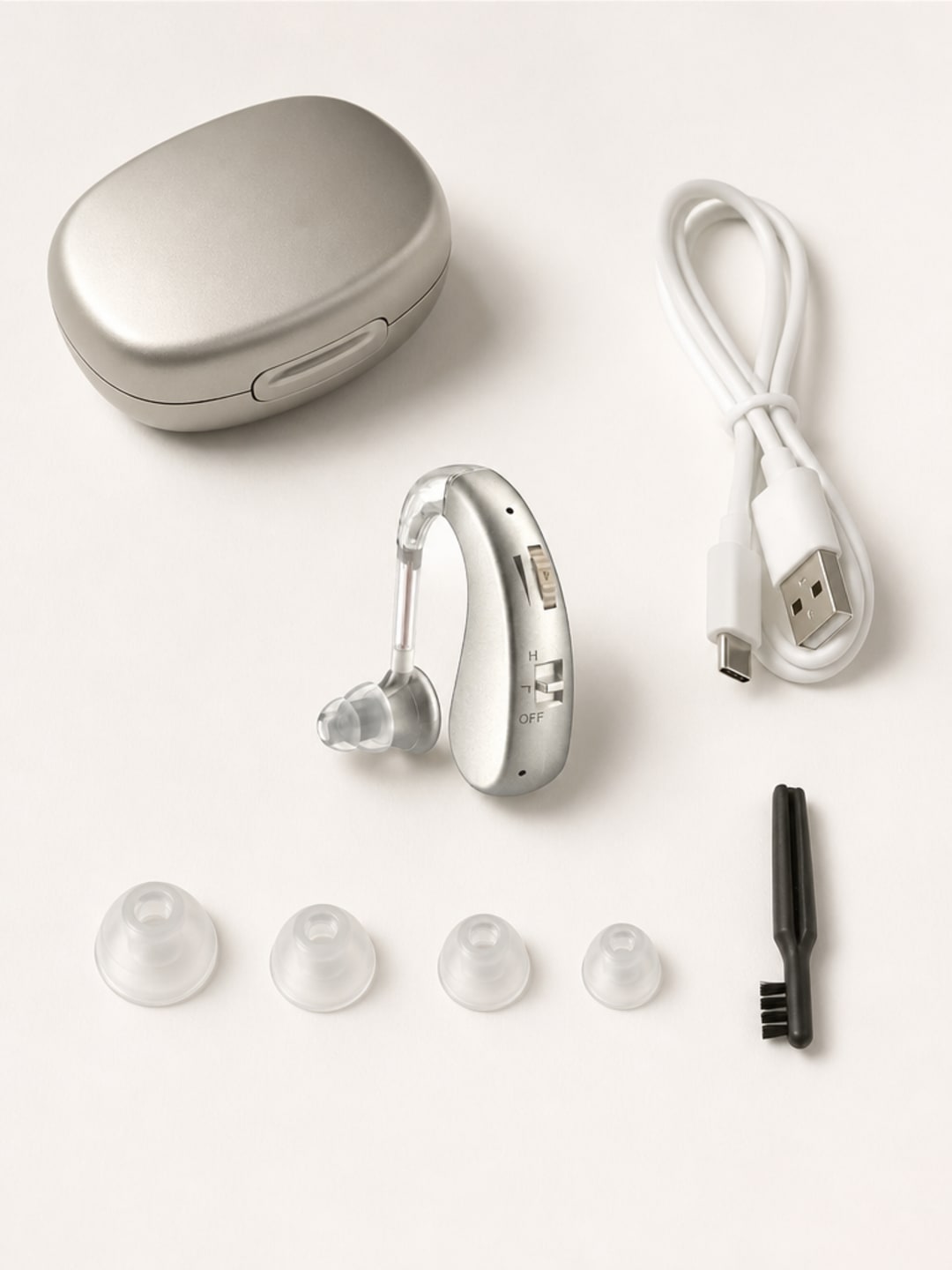
The landing page shows you the four silicone ear-tip sizes — S, M, L, XL — photographed alongside the device, so you can see the physical range before you commit to anything. Every included component: the device pair, the cleaning brush, the charging cable. The full fit-system instructions — how to find your size, how to seat the dome, what correct fit feels like vs. incorrect. The 30-day money-back return terms, in plain language — the window you have to verify the fit works in your ear, in your daily situations. The thing the last cheap pair was missing is four sizes. One of them is yours.