That Cheap Amplifier in Your Drawer Didn’t Just Waste Your Money. It Trained You to Think Every Affordable Hearing Aid Is Junk.
You already got burned. That doesn’t mean your next move has to be a $5,000 hearing aid — or another blind bet on a listing that overpromises.
You remember the package. The plastic. The listing that made it sound like you’d finally stop asking people to repeat themselves.
Then the week that followed: whistling. Muffled rooms. A volume control that either did nothing or turned the whole world into a cheap speaker. So it went in a drawer. Maybe a junk drawer. Maybe a nightstand you don’t open.
And a conclusion hardened fast:
Cheap hearing gadgets are a scam. If I want something that actually works, I have to spend thousands.
That conclusion is expensive. It also skips the only question that matters after a bad buy:
Was the problem “affordable”… or was it that you bought a vague gadget, got a vague result, and still don’t know what you actually need?
One disappointing amplifier is not a diagnosis. It is not proof that every low-cost device is the same toy with a different photo. And it is not a court order to write a $5,000 check before you’ve even compared what you’d be paying for.
If that last purchase left you allergic to another “miracle” ad, good. You should be. The next look should be at a product that tells you what it is — and what it isn’t.

Don’t Spend $5,000 Just Because the First One Failed

After a cheap device lets you down, your brain does something very human. It doesn’t just reject that product. It rejects the entire price range.
“If that one was a waste, I guess I need the real thing.”
In hearing, “the real thing” is often sold as $3,000, $5,000, sometimes more — wrapped in clinic visits, programming, and a feature list that sounds like a smartphone.
Some people need that path. Premium hearing aids can include advanced processing, professional fitting, follow-up adjustments, and tools built for specific hearing losses. You are not only buying a device. You are buying a service model.
That stack can be worth it. It is not automatically required because an inexpensive amplifier disappointed you.
Those two purchases are not the same product in different packaging. A personal sound amplifier from a random listing is not a hearing evaluation. A failed $30 gadget is not proof that your next option has to cost as much as a used car.
The trap is the leap: junk amplifier → therefore thousands.
That leap is how people overcorrect. They still want help with everyday hearing. They don’t want to get burned again. So they assume the only adult choice is the high-ticket one.
Before you decide the next check has to be five figures, you need a clearer picture of what you’d actually be paying for — and whether your day-to-day problem requires that entire stack.
Audexa sits in a different lane: a low-cost rechargeable behind-the-ear hearing aid at $69.99 a pair, built around essential functions, not a clinic-grade menu. It is not the $5,000 option. Treating $5,000 as the only “serious” answer to a bad Amazon order is how a $40 mistake becomes a $5,000 assumption.
Let’s Be Honest. Audexa Isn’t a $5,000 Hearing Aid. We’re Not Going to Pretend It Is.
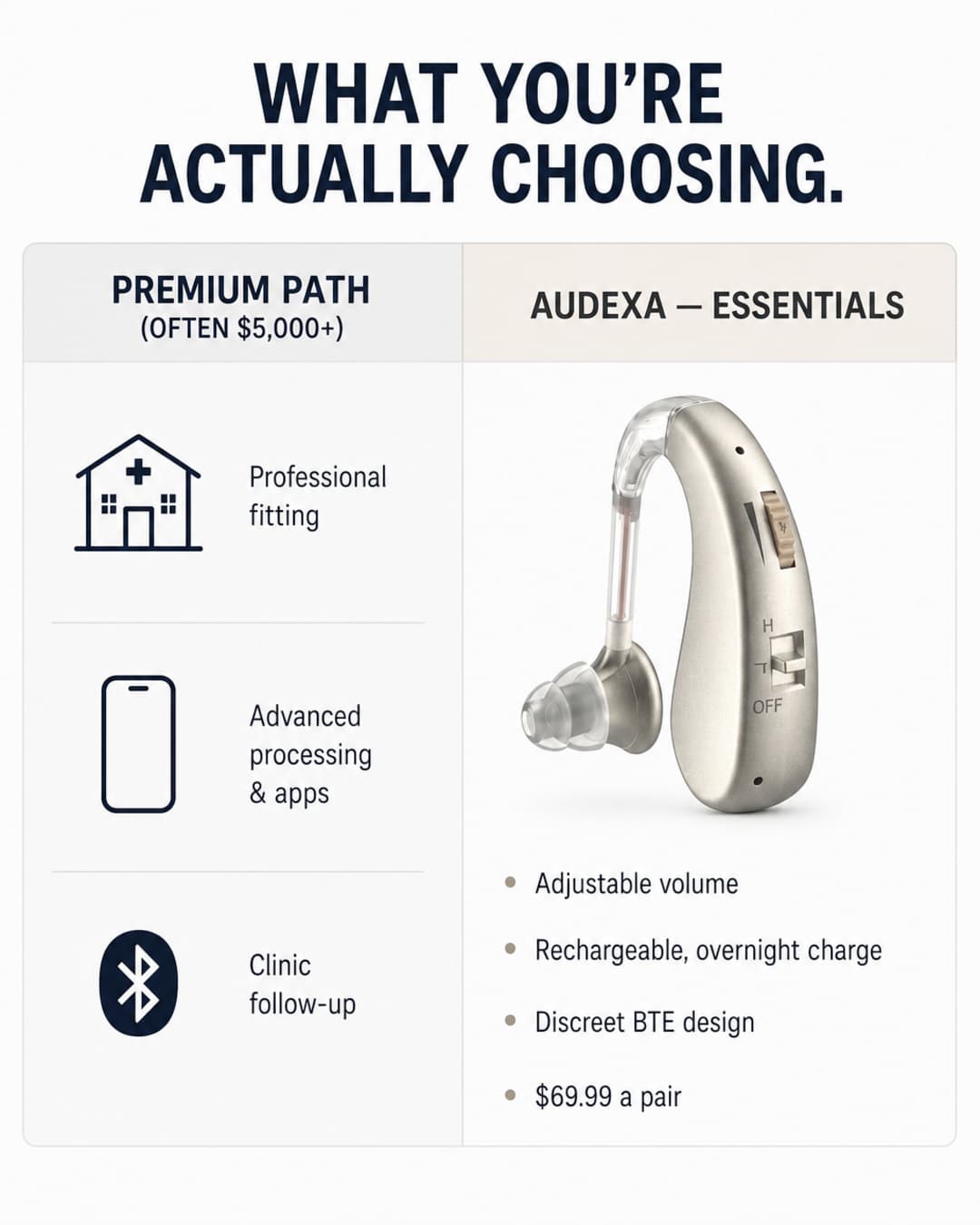
If you’ve already been burned, a bigger promise is the worst possible sales pitch.
So here is the version that doesn’t insult you.
Premium devices can include directional microphones, app control, Bluetooth streaming, tinnitus programs, wireless charging cases, audiologist programming, and in-office fine-tuning. That is a large part of why the invoice looks the way it does.
Audexa does not offer all of that. No fitting appointment. No claim that it is a technological twin of those systems. No “just like the expensive ones, but cheaper” nonsense.
What it actually offers is narrower — on purpose:
- Adjustable volume
- A rechargeable battery designed to last all day with an overnight charge
- A discreet, low-visibility behind-the-ear design
- Built for everyday wear, not a product-photo fantasy
- $69.99 for one pair, $139.99 for two pairs
- Always-free shipping, estimated delivery within 5 days
- A 90-day return policy, subject to the applicable terms
If you need every advanced feature and a professional fitting, this is not the product that replaces that path.
If what you wanted last time was something you could wear, charge, and turn up or down — without financing a device you might never fully use — then an honest description is worth more than another “life-changing” headline.
You already learned what happens when the ad outruns the hardware. This time, the hardware should be described as it is.
Don’t Take Another Ad on Faith. See Exactly What You’re Buying.

Last time, you bought a promise. Cropped photos. A title that said “hearing aid.” A pile of reviews that cancelled each other out. You couldn’t tell if you were getting a real behind-the-ear device or a toy amplifier with a silicone tip.
Don’t do that twice.
Audexa is a behind-the-ear hearing aid. The body sits behind the ear. A clear tube runs to a silicone ear tip in the canal. There is a volume control you can reach. A switch marked H / T / OFF. It charges with USB-C on the device — not a mystery dock you have to hunt for.
What’s in the package: two Audexa hearing aids, silicone ear tips in different sizes, a USB cable, and a cleaning brush.
That’s the kit. Not a clinic. Not a custom earmold from an audiologist. Not TV streaming through an app.
You should be able to picture putting it on, rolling the volume, plugging it in overnight, and deciding whether that matches the gap your last gadget never filled — before you spend another dollar on a listing fantasy.
If the last purchase felt like a lottery ticket, this step is the opposite: look at the actual shape, the actual controls, the actual charging port. Then decide.
The Question Isn’t How Many Features It Has. It’s Whether You’ll Use Them.

Hearing-aid marketing loves a laundry list. Noise programs. Spatial processing. Apps. Automatic scenes. Streaming. Geotagged adjustments.
Some of that is genuinely useful — for some people, in some environments, with a specific hearing loss, after a real fitting.
A lot of buyers never use half of it. They wanted the TV without blasting it. A conversation in the kitchen. Fewer “what?” moments in a normal day. They did not need a smartphone ecosystem attached to their ear.
The question that got skipped after your cheap amplifier failed was not “what’s the most advanced device on earth?” It was “which functions would actually change my day?”
Audexa is built around that smaller list: volume you can adjust, a battery you charge overnight, a design that doesn’t announce itself from across the room, and a price that doesn’t require a payment plan.
That is not a claim that extra technology is worthless. Extra technology is not free, and it is not automatically valuable to you.
If your last device failed because it was a poorly made noisemaker — not because it lacked Bluetooth — buying a $5,000 platform to punish a $40 mistake is how people overspend their way out of a bad review.
One Bad Amplifier Doesn’t Prove Every Affordable Hearing Aid Is the Same Device in a Different Box

You know the shortcut: cheap hearing thing = waste of money.
That shortcut protected you from buying the same junk twice. It also flattened every product under a certain price into one pile.
They are not one pile.
A no-name personal sound amplifier, a mystery “hearing aid” with stock photos, and a behind-the-ear rechargeable device with a volume wheel, a labeled switch, USB-C charging, and a defined offer are not interchangeable. “Inexpensive” is not a model number.
Your last device had its own design, its own limits, its own marketing. Audexa has a different shape, different controls, a different charging setup, and a different pitch: essential functions, stated plainly, at $69.99 a pair.
Nobody can honestly tell you it will outperform a gadget they never sat next to yours. What you can do is stop treating “I got burned” as a scientific result about an entire category.
Look at this product as this product. If it still isn’t for you, that’s a decision. If you refuse to look because the last one lived in a drawer, the last seller wins twice — once when you bought, and again when they trained you to overpay or give up.
Try Again With a 90-Day Safety Net — Not Another Blind Checkout

You’re allowed to be cautious. You already paid a stupid tax once.
Audexa includes a 90-day return policy, subject to the applicable terms. That is not a magic “no conditions, no fine print, send it back on a whim” slogan. Read the terms. Use the window to evaluate the actual device: how it sits behind the ear, how the volume behaves, how overnight charging fits your routine.
For someone who got burned, the point is not “trust the ad.” The point is you don’t have to decide an entire category in one unboxing night.
One pair: $69.99. Two pairs: $139.99. Shipping is free. Estimated delivery is within 5 days.
If essential functions were what you needed all along, the next step is not another leap of faith. It’s looking at the details with your last mistake in mind — and using the return window as it actually exists.
What Customers Are Saying
"I liked that they showed the actual device instead of another miracle listing. Easy to put on, and the volume control is straightforward."
Mark T., Columbus
"After a cheap amplifier that sat in a drawer, I wanted something that looked like a real behind-the-ear aid. Charging overnight is simple."
Linda K., Phoenix
"Clear about what you get for the price. Not fancy, but well made and easy to figure out."
James R., Tampa
You Already Know What a Bad Buy Feels Like. Don’t Let It Make the Next Decision for You.
That drawer is still there. So is the hearing problem that made you order in the first place.
You do not have to convert one failed amplifier into a $5,000 purchase you never fully understood — or into a permanent ban on every affordable hearing aid.
- One disappointing device is not a diagnosis, and it is not proof you must spend thousands.
- Premium hearing aids include features and services you may or may not need.
- Audexa is an affordable behind-the-ear option with adjustable volume, a rechargeable battery, and a discreet design — not a $5,000 clone.
- The 90-day return policy, under its applicable terms, exists so you can evaluate the real product instead of another listing promise.
If you’re done buying mystery gadgets — and not ready to assume five grand is the only remaining door — look at what Audexa actually is.
See the device, the price, and the return terms. Decide with your eyes open.