A $69.99 Hearing Aid Isn’t a Scam. A $5,000 One Isn’t Automatically Smarter Either.
If a low price makes you suspicious, good. You should be. You should also know exactly what you’re buying — and what a premium pair is actually charging you for — before you spend another dollar.
You didn’t get skeptical by accident.
You got skeptical because this category lies in both directions. One side quotes you like you’re buying a used car: custom fitting, Bluetooth, “AI,” follow-up visits, and a number that starts with a five and ends with three zeros. The other side screams restore your hearing tonight over a blurry gadget photo and a countdown clock.
So when you see a pair of hearing aids for $69.99, your brain does the only math it was trained to do:
If this worked, it wouldn’t cost that.
That sentence has emptied more wallets than any clinic ever did.
Because “expensive” got confused with “right for you.” And “cheap” got confused with “junk” — usually before anyone showed you the actual device, the actual controls, or the actual list of what you’d be paying for.
Audexa is a low-cost, rechargeable, behind-the-ear hearing aid. One pair is $69.99. Two pairs are $139.99. Shipping is always free. Delivery is estimated within 5 days.
It will not pretend to be a professionally programmed, clinic-fitted, Bluetooth-stuffed instrument. If that’s what you need, go get that. You’re allowed to need it.
If what you need is an affordable device with adjustable volume, overnight charging built for all-day use, and a discreet shape you can live with — you owe yourself five minutes with the product, not the price tag.
Start by looking at the thing. Not the myth around it.

No Miracle. No “Breakthrough.” This Is the Product.
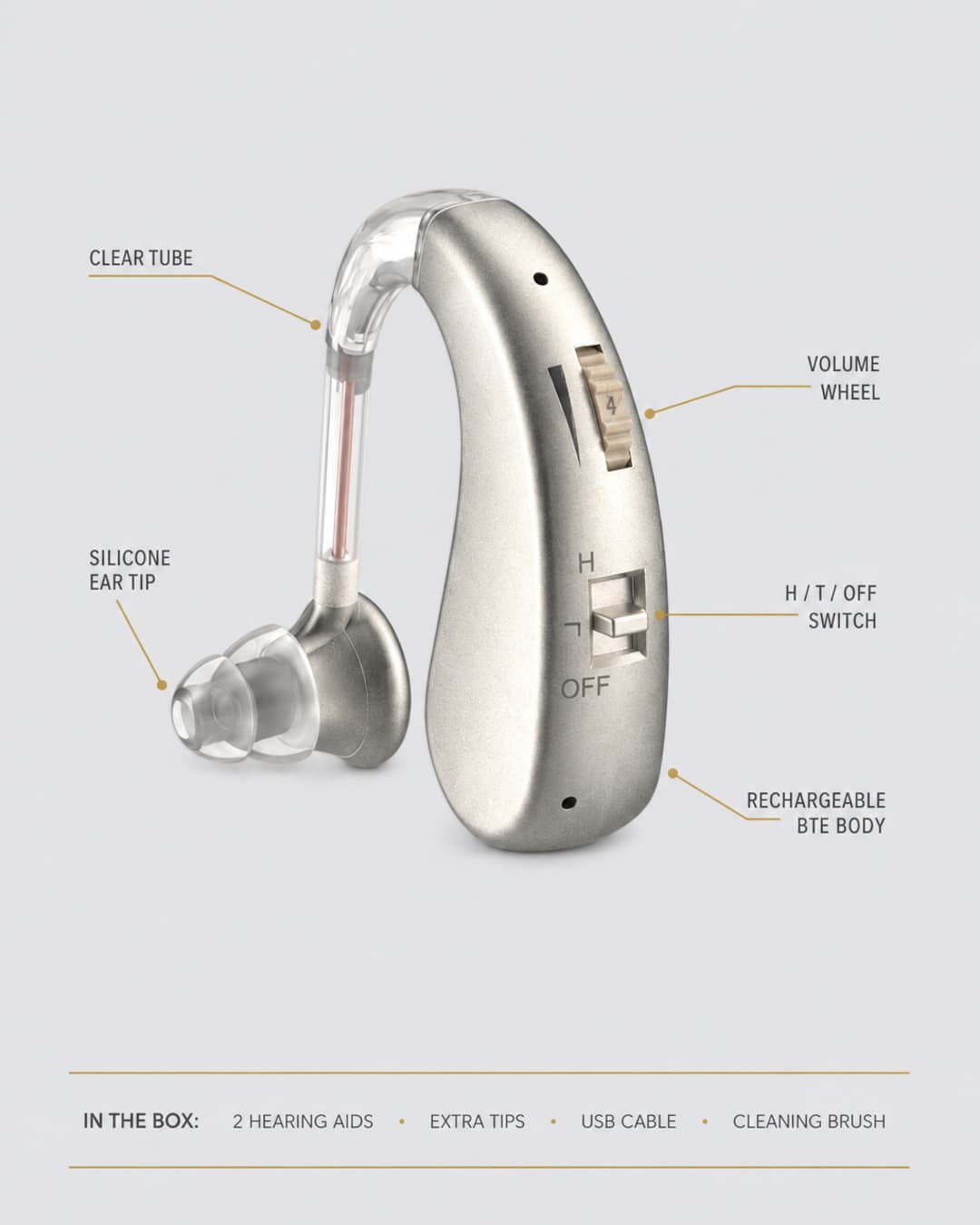
Cheap hearing ads hide the device on purpose.
They show a smiling couple on a boardwalk. They say “clinically inspired.” They never let you stare at the plastic, the tube, the switch, and the wheel — because once you see it’s a small machine and not a magic spell, the fantasy dies.
Audexa is a behind-the-ear hearing aid. Champagne-colored body. Clear tube. Soft silicone ear tip. A volume wheel you can turn with a fingernail. A switch marked H, T, and OFF. A rechargeable battery you top up with a USB cable instead of peeling those tiny tab-batteries every few days like it’s 1998.
That’s the product.
In the box: two Audexa hearing aids, silicone ear tips in different sizes, a USB cable, and a cleaning brush.
Not a “hearing system.” Not a doctor in a dongle. A pair of hearing aids you can hold, charge, wipe down, and adjust.
If that sounds underwhelming, it should. Underwhelming is the opposite of a miracle claim. Miracle claims are how people get burned. This is how people buy something they can actually evaluate.
The $5,000 pitch counts on you never looking this closely at a $70 option. So look.
Four Functions. That’s the Whole Performance Story. Judge It Anyway.

Skeptical buyers don’t need another adjective. They need the list.
Adjustable volume. You set it. You change it when the room gets loud or the conversation drops. You’re not stuck on one factory blast that either screams or disappears.
Rechargeable battery. Charge it overnight. It’s designed to last all day. No weekly scavenger hunt for zinc-air tabs. No “I left the batteries in the other jacket.”
Discreet, low-visibility design. It sits behind the ear. The tube is clear. The body isn’t a billboard. If you’ve been putting this off because you didn’t want the whole grocery line clocking a hearing aid, the shape is built to stay out of the way.
Comfort for everyday use. Store. Kitchen table. TV. Phone call. That’s the job — not a lab demo, not a concert-hall simulation, not a promise we can’t cash.
None of that is magic. It’s the documented feature list.
If those functions match what actually bothers you — speech at dinner, a long day without battery panic, not advertising your hearing to strangers — then $69.99 stops looking like a red flag and starts looking like a decision.
If you need custom programming mapped to an audiogram, directional mics managed by a specialist, and streaming into your phone, Audexa is not that product. Saying so isn’t a weakness. It’s the difference between an honest offer and another ad that hopes you won’t notice.
$5,000 Buys a Lot of Technology. The Question Is Whether You’ll Ever Use It.

This is the part clinics skip and cheap ads fake.
Premium hearing aids can include real things:
- A professional fitting and follow-up visits
- Bluetooth streaming to your phone
- Advanced noise reduction and directional processing
- Custom earmolds
- Fine-tuning software tied to a hearing test
Those features are not imaginary. For some people, they’re worth every dollar. Complex hearing loss. All-day noise. You want a clinician on the settings. You stream calls. Pay for that. Don’t let an internet page talk you out of care you actually need.
Now the other half — the half nobody prints on the brochure:
A lot of people never use half of what they financed.
They don’t pair Bluetooth. They skip the follow-up. They wanted the TV lower and their spouse clearer at dinner. They walked out with a device built like a smartphone and a bill built like a medical procedure.
That’s not “premium is a scam.” That’s features can be futile if you will never use them.
Audexa’s offer is narrower on purpose:
- Adjustable volume
- Rechargeable battery
- Discreet BTE design
- Everyday wear
- $69.99 a pair — or $139.99 for two pairs
- Free shipping, estimated delivery within 5 days
- A 90-day return policy, subject to the applicable terms
You’re not choosing “better vs. worse.” You’re choosing relevant vs. unused.
More technology does not automatically mean more value for every person. The expensive mistake is paying for a cockpit when you needed a volume wheel.
Don’t Take the Ad’s Word. Take the Boring Reviews — Then Decide.

Advertising is easy to fake. Lived-in use is harder.
If a low price already makes you twitch, you already know to ignore the five-star poems that sound like they were written in a marketing meeting. Look for the boring comments. That’s where the product shows up.
People who actually wear an affordable hearing aid don’t write hymns about “getting their life back in 10 minutes.” They talk about whether they could turn the volume without taking it off. Whether it stayed charged through a long day. Whether the ear tip was comfortable enough to leave in. Whether anyone noticed it. Whether $70 felt smarter than a financing plan — or whether they still needed more than a basic device.
That’s the proof that matters here. Not a celebrity. Not a lab coat. Ordinary, specific, sometimes mixed experiences you can weigh against your ears, your rooms, your patience.
Some people will say it’s enough. Some people will say they needed more. Both of those are useful. An honest product can survive the second kind. A miracle claim can’t.
Before you decide Audexa is “too cheap to work” or “the answer to everything,” read what real buyers say about the actual device — comfort, charging, controls, and whether they’d buy it again. Then match that to what you need. Not to a $5,000 brochure.
90 Days. Not a Dare. A Window With Rules.

The objection you don’t say out loud:
What if I buy it and it sits in a drawer next to the last thing I regretted?
Audexa comes with a 90-day return policy, subject to the applicable terms. That is not “risk-free forever, no questions, we eat every cost, keep the extras.” Read the terms. Use the window.
Ninety days is long enough to wear it at dinner, on a call, at the store, and in a quiet room. Long enough to know if adjustable volume and a rechargeable behind-the-ear device are what you needed — or if you should be sitting with a specialist instead.
The policy is not there to hypnotize you. It’s there so the price tag doesn’t make the decision for you. You can test the real product against real days, then keep it or send it back under the rules that apply.
If a company needs you to be afraid of returning it, they already told you what they think of the product.
What Customers Are Saying
“I was skeptical because of the price. What convinced me was the volume wheel — I can turn it up a bit when my wife is in the other room and back down when the TV gets loud. No app, no fuss. It just works for what I need.”
James T. · Age 68
“Charging it overnight is the part I like most. I put it on the charger when I go to bed and it’s ready in the morning. No more hunting for those tiny batteries. It’s not fancy, but it stays in all day.”
Margaret R. · Age 71
“My daughter bought these for me. I was worried I’d feel self-conscious, but the color is low-key and the tube is clear. People don’t notice it unless I point it out. The different ear tips helped me find one that doesn’t hurt after a few hours.”
Robert K. · Age 74
“I compared it to the $4,000 quote I got at the clinic. For what I actually use — conversations at the table and the TV — this is enough. The 90-day window let me test it properly before deciding. I kept it.”
Linda M. · Age 66
“The H/T/OFF switch is simple. I leave it on the setting that works for talking and only switch it if the room gets noisy. No complicated menus. After three weeks I still use it every day.”
David P. · Age 70
“I bought the two-pair deal so my wife and I both have one. Hers sits a little differently behind the ear, but the extra tips made it work. We both charge them at night. For the price, it’s been practical.”
Susan & Mark L. · Ages 67 & 69