The Real Reason Conversations Got Harder — And Why Almost Nobody Figures It Out for Years
Most people notice it happening. Almost none of them know what to call it. A closer look at the science of how we follow speech — and why it quietly slips away without anyone saying a word.

There's a particular kind of silence that isn't silence at all. Someone across the dinner table says something, and you hear the sentence — the shape of it, the rhythm — but the words themselves arrive blurred at the edges, like a photograph slightly out of focus. You fill in the gaps. You nod. The conversation moves on, and if the gap you filled in was wrong, you won't find out until later, if ever.
Most people who experience this don't think of it as a medical development. They think of it as the room being too loud, or the speaker being too soft, or — this is the most common explanation of all — that people have simply started mumbling more. It feels like a judgment about others, not a fact about yourself.
What makes this interesting, and what researchers who study it find quietly remarkable, is that this isn't an accident. The way the drift happens — and the reason it goes unnamed for so long — has a great deal to do with how the brain processes sound, not just the ear. And understanding that distinction changes what you'd actually do about it.
The Brain Does Most of the Work. That's the Part Nobody Tells You.
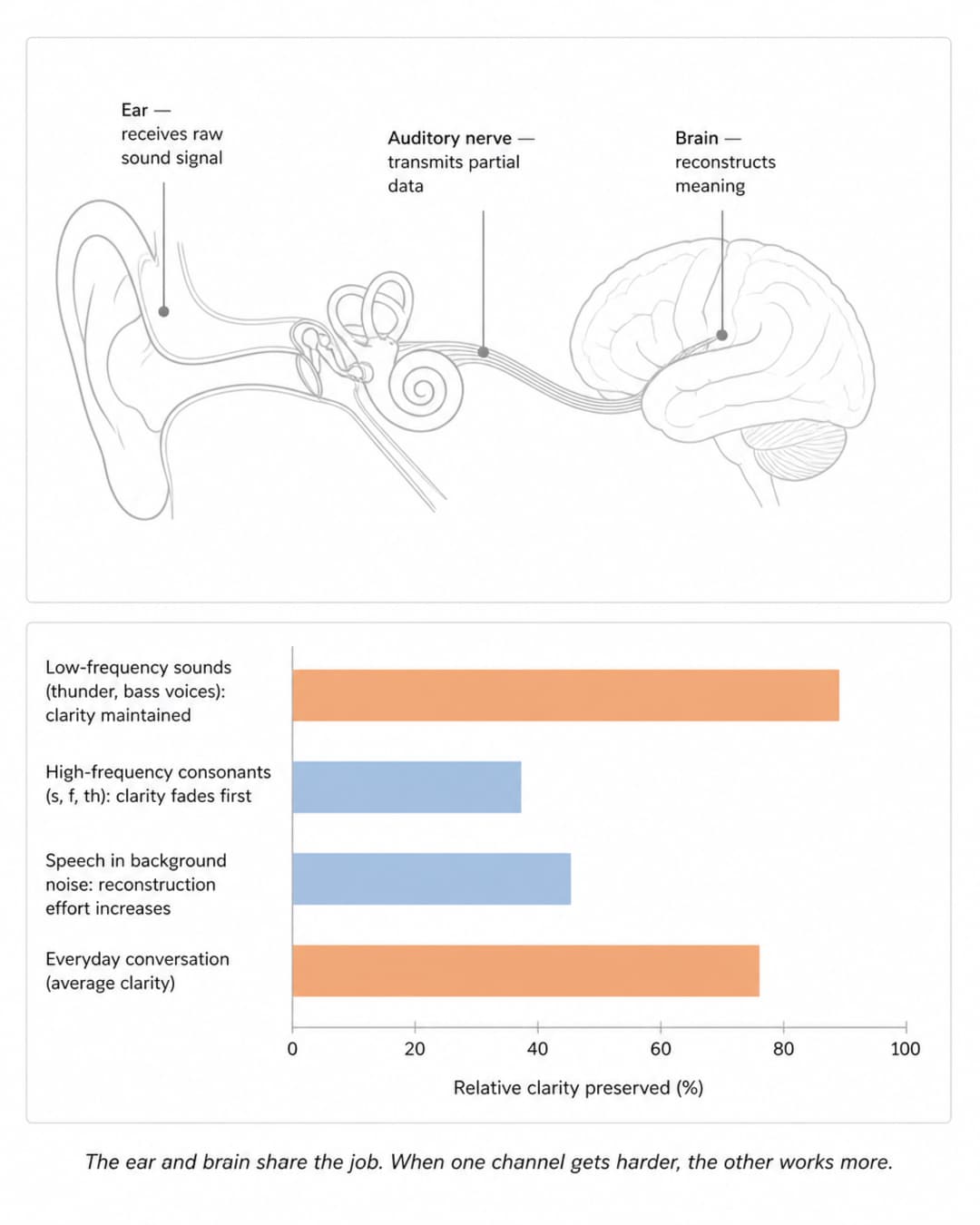
When sound arrives at the ear, the raw signal is incomplete by design. What you actually experience as a conversation is a reconstruction — the ear passes fragmented acoustic information up the auditory nerve, and the brain fills in the rest, drawing on context, memory, expectation, and pattern recognition built up over decades of listening. Under ordinary conditions this happens so fast and so invisibly that it feels like simple hearing.
The catch is that reconstruction takes effort. And as the signal gets harder to read — quieter consonants, overlapping voices, background noise — the brain has to work harder to finish the job. It can do this successfully for a long time. So successfully, in fact, that a person can lose significant clarity in certain frequency ranges while still following most conversations in quiet rooms, without ever registering that anything has changed.
What changes first are the conditions, not the conversations. Louder rooms become harder. Certain voices — particularly higher-pitched ones, which sit in the ranges where clarity often fades earliest — start to feel less distinct than others. The television gets turned up another notch.
The gap between noticing something and acting on it averages close to a decade. It's a pattern that shows up consistently across the research — not as an anomaly, but as the norm.
We Looked at What's Currently on the Market. It's a Complicated Picture.

For most of the past several decades, the options for anyone who suspected their hearing had shifted fell into two sharply different categories: an expensive clinical appointment that might result in a prescription device costing several thousand dollars, or nothing.
The first option has obvious barriers. Prescription hearing aids average around $4,727 per pair without insurance, according to a 2025 HearingTracker analysis of 879 purchases — a figure that excludes the consultation costs, fitting appointments, and follow-up visits that typically accompany them. For people on fixed incomes, or simply for people who weren't certain they needed something so significant, the threshold was prohibitive.
The second option — doing nothing — has consequences that aren't always obvious at the time. Research consistently documents that the average person waits nearly ten years between first noticing a change in how they hear and doing anything about it. During that window, the practical costs tend to accumulate quietly: conversations missed, relationships strained in small ways, a gradual narrowing of the environments where someone feels comfortable participating.
"You've sat at a table with people all around you and you can hear them talk but can't understand what they say. It's a terrible feeling. Especially when you can't understand your family."
What's striking isn't the gap itself. It's how consistently people report the same trajectory: the adjustment period, the gradual acceptance of a smaller conversational world, and then — eventually — the moment when someone asks why they waited so long. Between these two poles, the market has had very little to offer that most people would trust.
A Rule Change in 2022 Quietly Opened a Third Option. Very Few People Know About It.
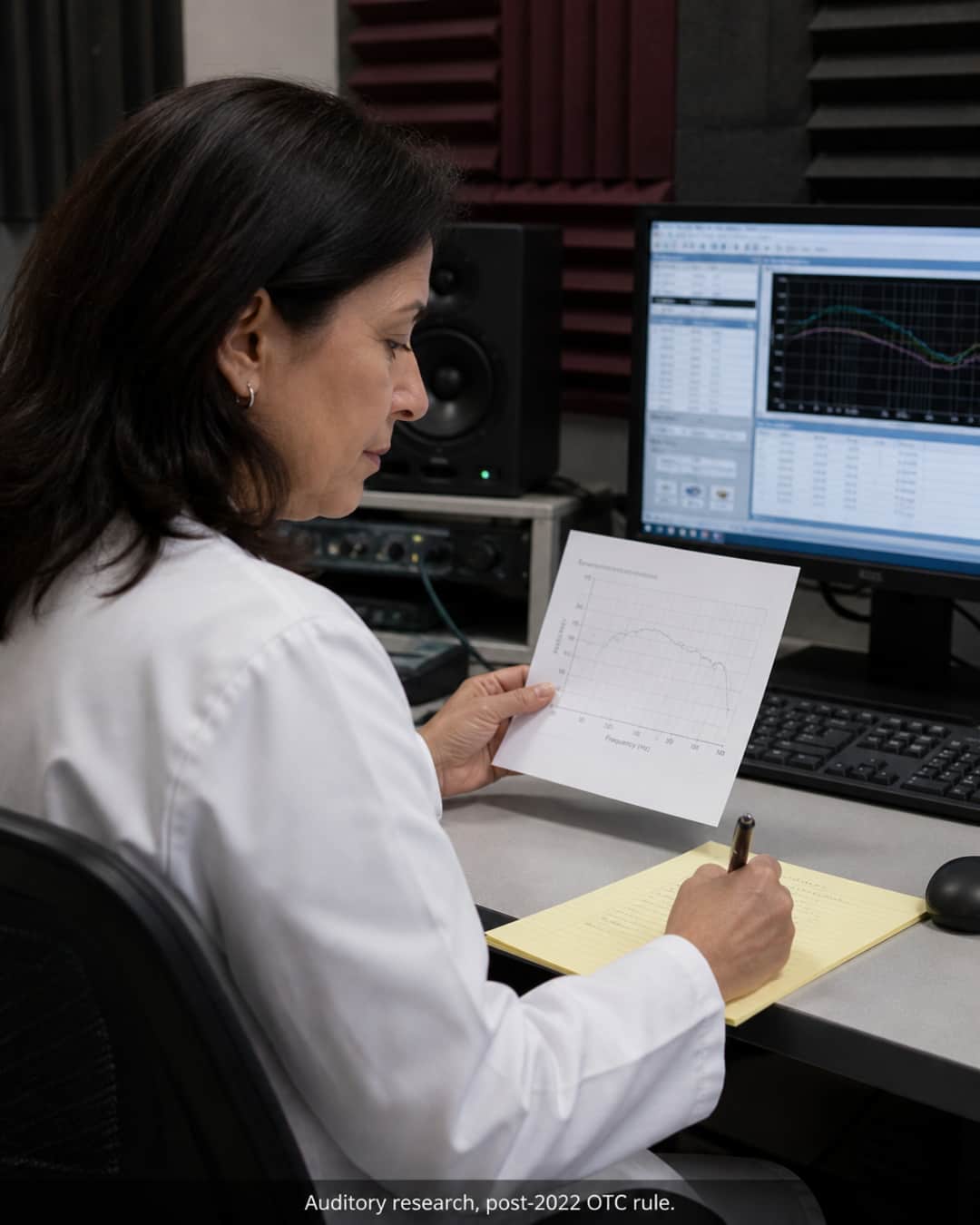
In October 2022, the U.S. Food and Drug Administration enacted a rule that most consumers never heard about. Under the Over-the-Counter Hearing Aid Act, adults 18 and older with self-perceived mild-to-moderate hearing difficulty became legally entitled to purchase a hearing device without a prescription, without a clinical evaluation, and without an audiologist's involvement.
The rule had been in progress for years, backed by consumer advocacy groups and researchers who argued that the existing regulatory framework had effectively priced the majority of people who could benefit from any device out of the market entirely. When it passed, it created space for a category of device that hadn't previously existed in any legitimate form: a properly manufactured, user-adjustable, rechargeable hearing device that a person could try at home.
The distinction between this and the cheap amplifiers that had always been available is technical but meaningful. Amplifiers simply make everything louder — all frequencies, all sounds, indiscriminately. What the 2022 rule enabled was a category of device designed specifically to improve speech clarity, fitting standards, and usability — built to the kind of specifications that allow a person to wear it through a dinner conversation and actually follow what's being said, not just hear that something is being said.
For most people, the question now is whether they've heard about it — and what, specifically, the category it created actually produced.
This is what hearing researchers and consumer advocates have been pushing for since 2022. See what we found →
Since this article was first published, our editorial desk has received a consistent volume of reader messages asking the same question: given that the 2022 OTC rule exists, what actually meets the standard it was designed to enable? One product kept coming up — enough times, from enough different directions, that we felt it was worth a closer look.
Audexa: What the New Category Was Supposed to Look Like

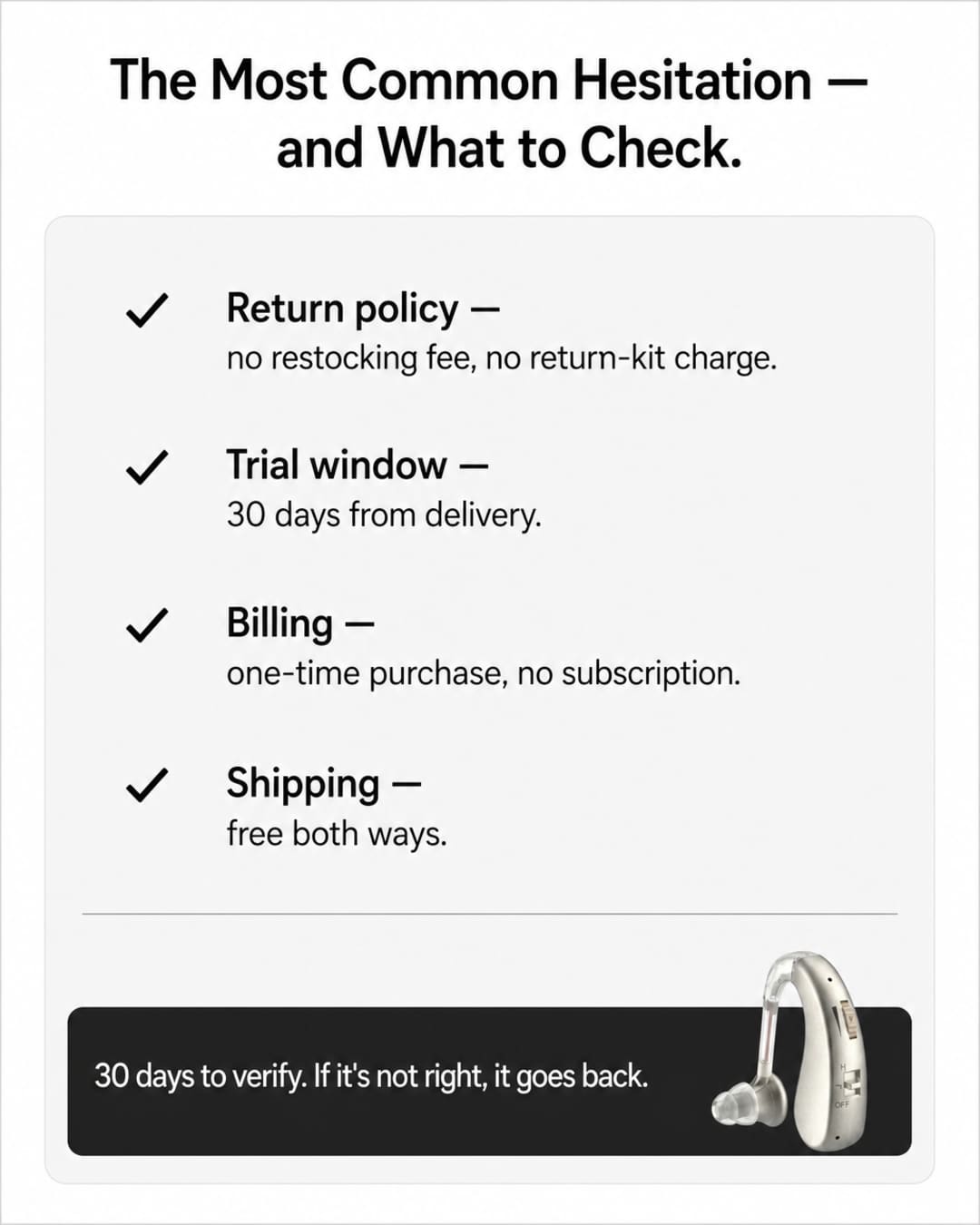
The device that stood out in our editorial research is called Audexa. It's a behind-the-ear rechargeable hearing device — the BTE form that sits discreetly behind the ear alongside glasses, with a small acoustic tube that routes sound into the ear canal.
What separates it from the amplifiers that gave the low-cost category its reputation is the combination of fit and adjustability. Audexa ships with four silicone ear-tip sizes, which matters considerably: the primary reason cheap devices whistle and feed back is a dome that doesn't seat properly against the ear canal, allowing amplified sound to leak out and cycle back in. A proper fit eliminates most of that. The volume adjusts via a top-mounted dial — a straightforward control that doesn't require fine motor precision — and the device itself is rechargeable, running up to 48 hours on a single four-hour charge via standard USB.
There's no prescription involved. No clinic visit, no audiologist appointment. The user sets the volume to a comfortable level, selects the ear-tip size that fits, and wears it. That's the mechanism — and for someone who has been working hard to follow dinner conversations in rooms that have felt increasingly noisy, the difference between a properly fitted, appropriately amplified signal and unaided hearing in the same environment is the point of the whole exercise. The $4,727 average for prescription devices makes any honest, lower-cost alternative look either suspicious or significant. Audexa is the latter.

- ✓Behind-the-ear, rechargeable — up to 48 hours per charge via standard USB
- ✓Four silicone ear-tip sizes included — fits discreetly alongside glasses
- ✓User-adjustable volume dial — no prescription required, no clinic visit
What People Who've Tried It Actually Say
The most consistent thing in the reader responses we reviewed wasn't about volume. It was about the specific experience of following a conversation — at a dinner table, on the phone, across a counter — that had previously required concentration hard enough to be tiring.
"I hear my keyboard clacking away as I type — this is a new experience for me."
Small observations like that one tend to be more informative than dramatic claims. They describe the texture of ordinary experience — the background sounds, the low-stakes moments — shifting back into range. Not a transformation, but a return. The people who reported the clearest benefit tended to describe the same starting point: not an inability to hear loud sounds, but a specific difficulty parsing speech in environments with any background noise at all, or with speakers whose voices sat in a higher register. Which tracks with what the research on early-stage hearing difficulty consistently shows — it's the frequency-specific, context-dependent losses that go unnamed the longest, because they don't feel like loss at all until you know what to compare them to.
For the readers who asked us to follow up — here is what we found. See what we found →
The One Thing Most People Ask First
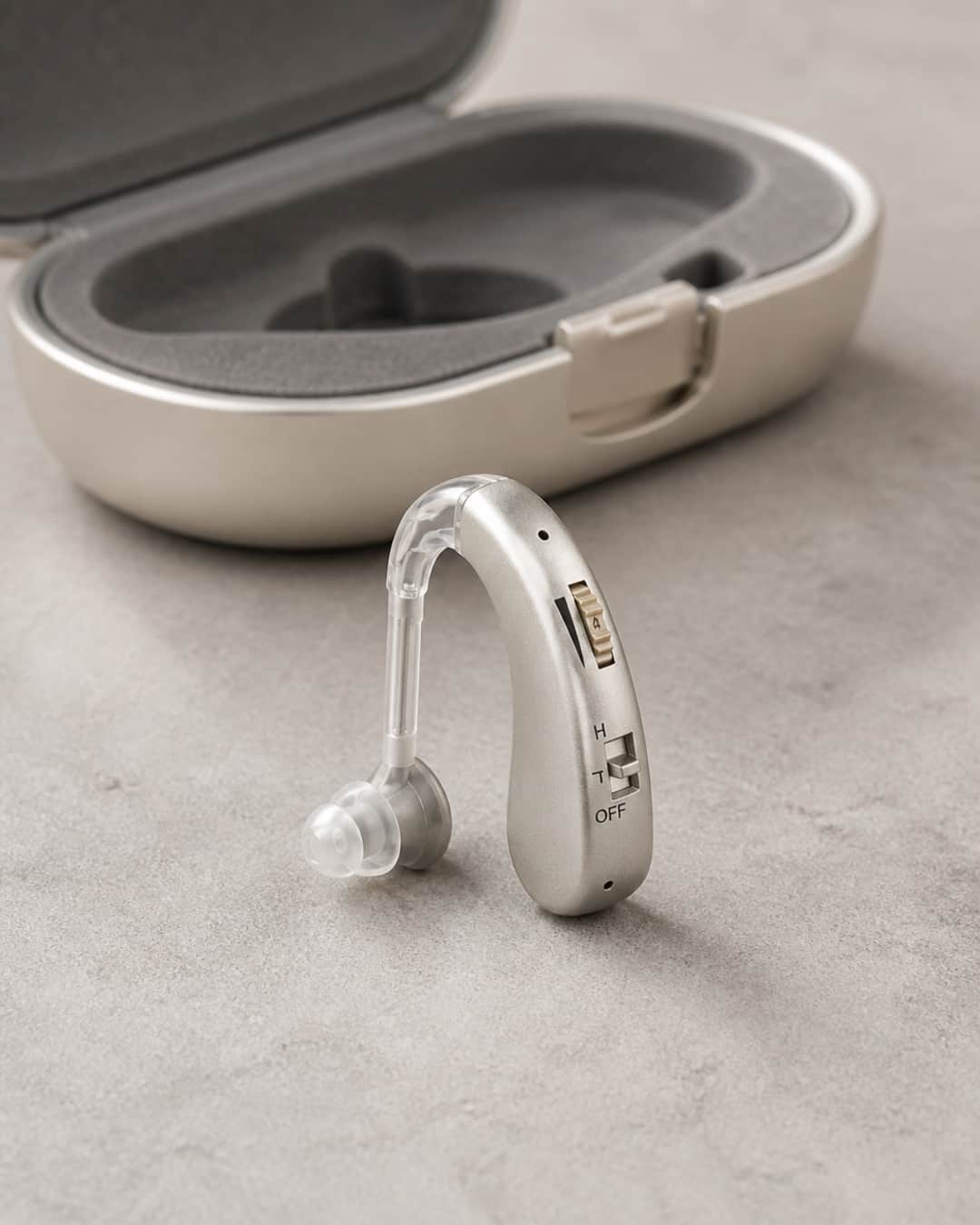
The most common response we heard from readers who were interested but hadn't acted was a version of the same hesitation: they'd seen products like this advertised before, and hadn't trusted them.
It's a fair instinct. The category has a real history of return policies that turn out to involve fees, windows that close faster than advertised, and customer service that evaporates after the purchase. That reputation is documented, and any honest look at the OTC hearing device space has to acknowledge it.
What Audexa states — and what anyone considering it should verify on the product page — is a 30-day money-back return policy with no restocking fee and free US shipping in both directions. The trial period exists specifically so that a person who tries the device and finds it doesn't meet their needs can return it without a penalty. That framing — thirty days to find out whether it does what it's supposed to do — is, at this price point, the most honest way to evaluate a device that only works if it fits the specific ear and the specific listening situations of the specific person wearing it. If the policy holds, there is genuinely very little to lose by finding out.

"The Ten-Year Gap: Why Most Adults Wait So Long — And What Changes When They Don't"
SoundSense Quarterly · Health & Wellbeing
"One Dinner Table. Four People. One Person Who Didn't Catch a Word of It."
SoundSense Quarterly · Real Life