Before You Try Another Hearing Device, Read This: The Real Reason Millions of Americans Are Still Asking "What?" — And the Option Most of Them Have Never Heard Of
For adults 60 and older who already know conversations are getting harder to follow — and are tired of the two options everyone keeps offering them.
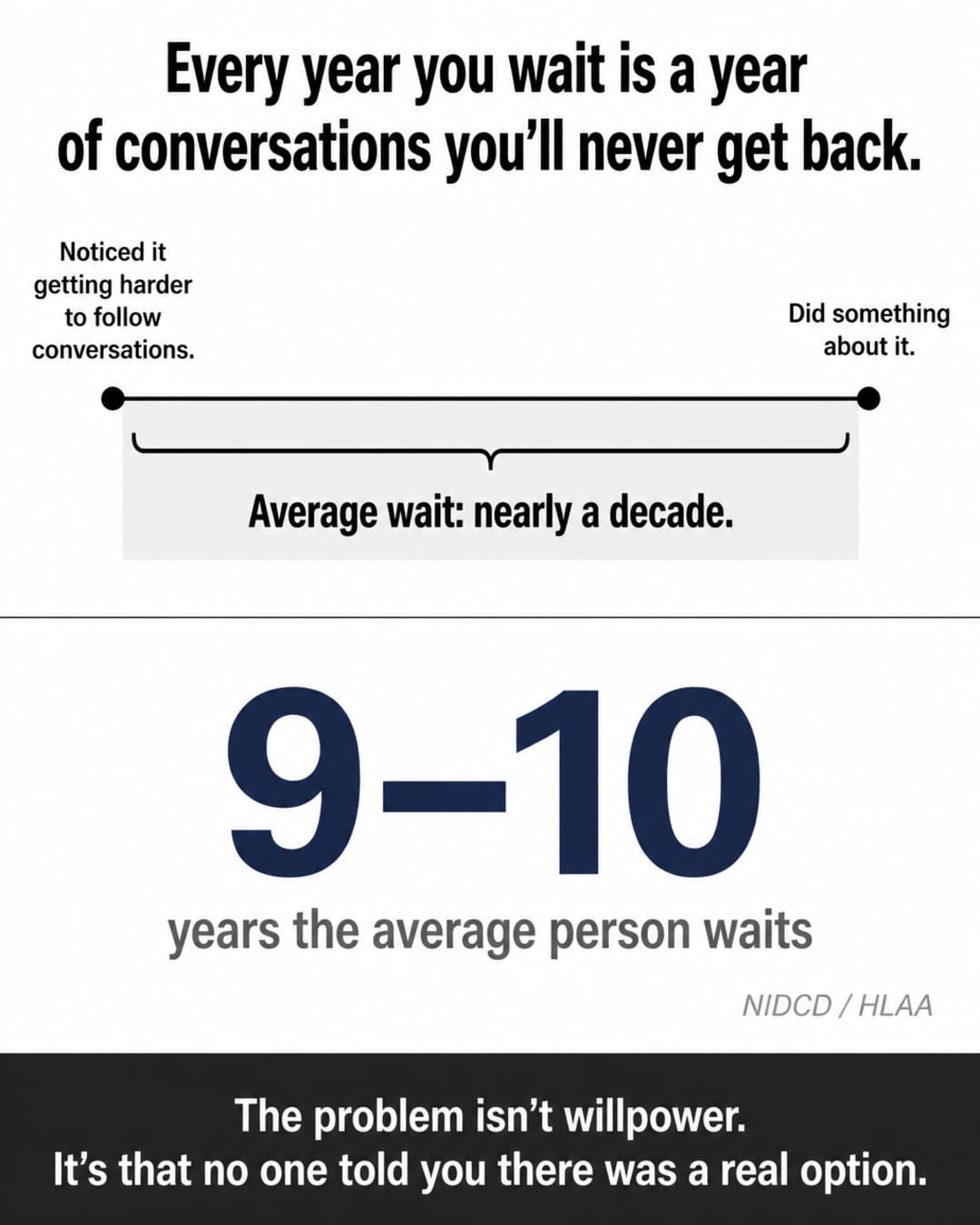
You already know something's off. You've been at the table. You've leaned in. You've asked twice — and then once more — and watched the moment close. This piece is not about convincing you there's a problem. It's about why the problem keeps going unsolved, and what changed two years ago that most people still don't know about.
There is a specific kind of tired that people who have trouble following conversations know and almost never talk about. It isn't the tired that comes from a long day. It's the tired that comes from working — invisibly, constantly — to fill in what you missed. The half-heard sentence you reconstruct from context. The name you didn't catch but nodded at anyway. The joke you laughed at two beats late because you needed a moment to piece it together from the faces around the table.
And then there's the other moment. The one that's harder to admit.
You ask once. You ask again. And the person across from you — your son, your daughter, your wife of forty years — says, "Just forget it."
Not unkind, necessarily. Just tired of repeating themselves. And you smile. You nod. You look like you heard.
You didn't.
"After repeating themselves two or three times and I still don't get it, they'll say 'just forget it.' It is an awful feeling that at times makes me pretend that I heard… and reply with a slight smile and a nod."
That quote wasn't written by a doctor. It was written by someone describing a Tuesday.

The dinner table is the most common place this happens, but it's not the only one. It happens at the pharmacy counter, when you lean way over to read the pharmacist's lips and still ask her to repeat the dosage. It happens on the phone with your grandchildren, when you catch maybe every third word and hope your answers make sense. It happens in the car, when everyone's talking and the road noise swallows the last half of every sentence, and you've started just watching the scenery.
What makes it worse isn't the missing words. It's what happens after: the small recalibration, the slight withdrawal. The way you start avoiding the restaurant because the noise is too much. The way you turn down the family gathering because you know you'll spend three hours smiling at things you didn't hear and come home exhausted.
"You've sat at a table with people all around you and you can hear them talk but can't understand what they say. It's a terrible feeling. Especially when you can't understand your family."
This is not a small inconvenience. It is, quietly and gradually, a subtraction from your own life.
Why What's Out There Falls Short
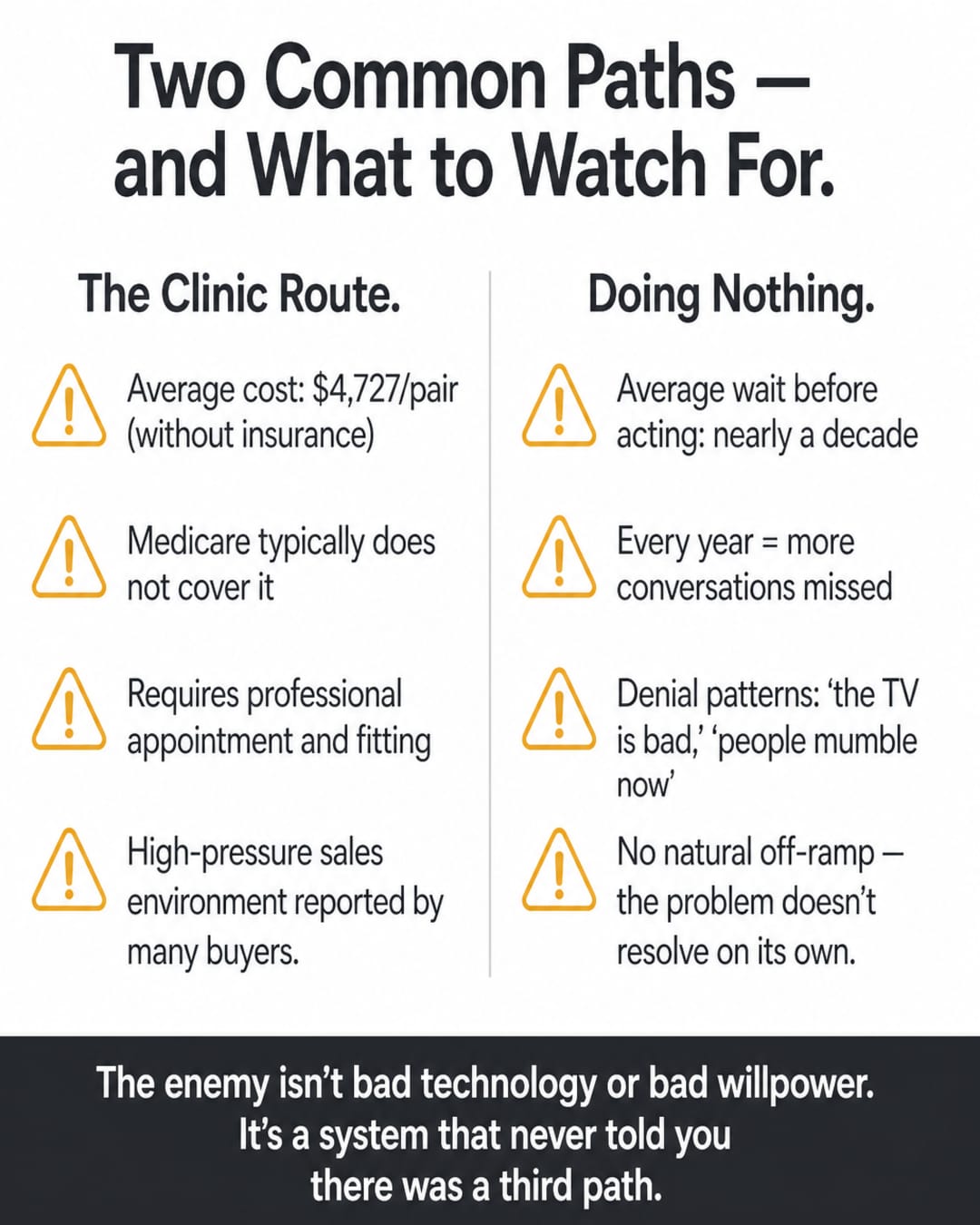
If you've started paying attention to this — if you've mentioned it to a doctor, or looked it up, or quietly hoped someone would offer you something useful — you've probably run into the same two answers.
The first is the audiology clinic. A hearing test, a professional fitting, a pair of prescription aids that cost somewhere between four and seven thousand dollars. And those numbers are real: the current national average for a pair of prescription hearing aids is $4,727 — without insurance (HearingTracker, 2025, survey of 879 purchases). Medicare doesn't cover them. Many private plans don't either. You walk out of the consultation with a quote and the distinct feeling, as more than a few people have put it, that the price tag has less to do with the technology than with the building you're sitting in.
The second answer is doing nothing. Waiting. Telling yourself it's not that bad yet, or that everyone mumbles now, or that the TV is just a bad brand. The average person waits nearly a decade from first noticing the problem to doing anything about it. A decade of asking "what?" A decade of smiling and nodding.
Here is what neither of those answers tells you: there is a third option that most people researching this have not found yet — and it became legal, at a federal level, less than three years ago.
But before we get to that, it's worth understanding why the two familiar options keep failing people.
"$6,500… After two days I cancelled my order. I felt that I'd been conned."
The clinic model was built around a system — audiologist, fitting, follow-up, manufacturer markup — that made sense when hearing technology required professional calibration. That system still exists. For some people with complex hearing needs, it is the right choice. But for the much larger group of adults with self-perceived mild-to-moderate difficulty following speech, the clinic model charges for infrastructure and intermediaries, not just for the device in your ear. The "do nothing" path isn't really a choice at all. It's the cost of not knowing there's another one.
The Rule Change Most People Missed
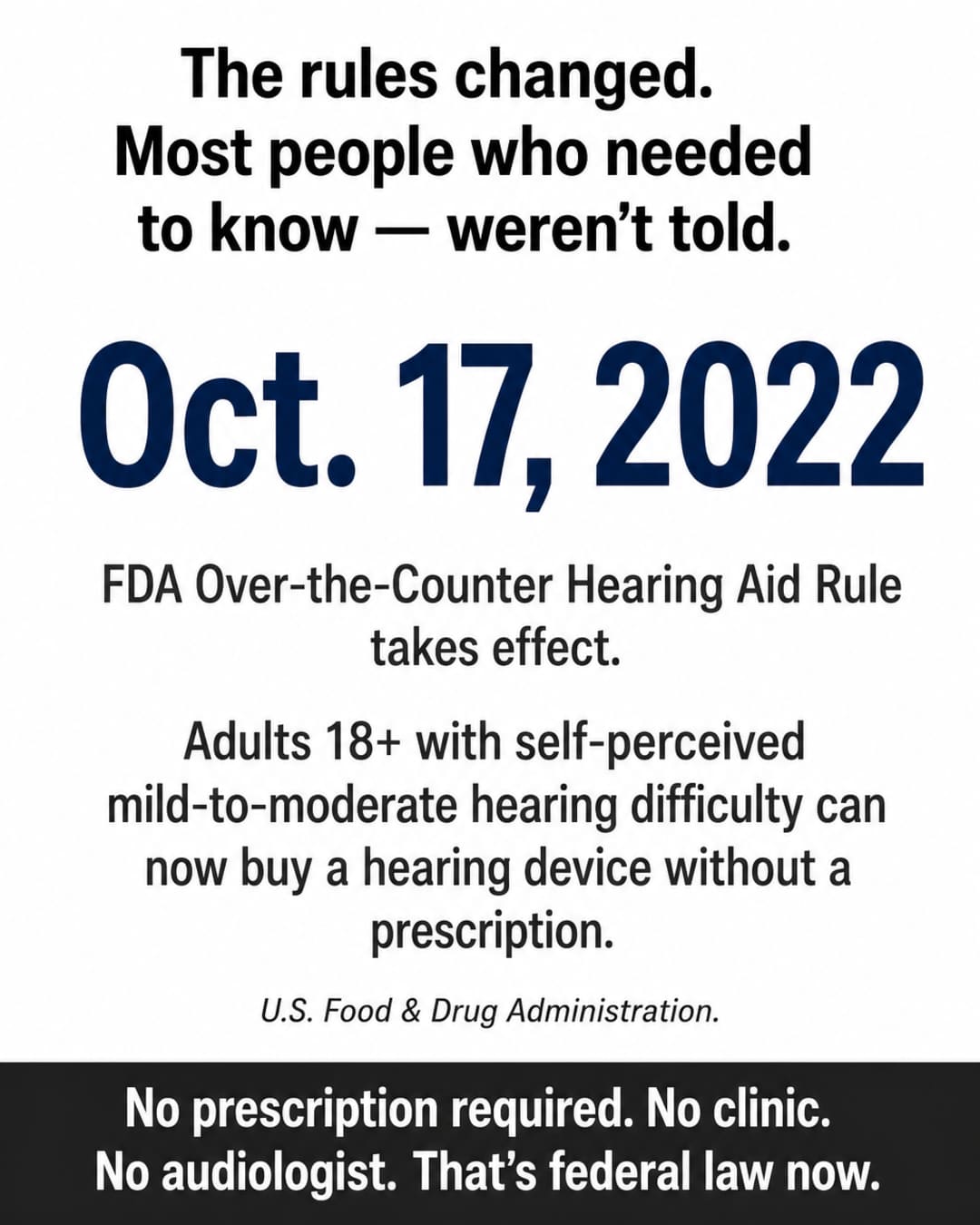
In October 2022, the FDA changed the rules. For decades, buying a hearing device legally meant going through a licensed audiologist. The prescription requirement locked most of the market behind a clinic door — and behind a four-figure price point. That changed with the Over-the-Counter Hearing Aid Rule, which took effect October 17, 2022. Under the new rule, adults 18 and older with self-perceived mild-to-moderate hearing difficulty can legally purchase a hearing device without a prescription, without a clinic visit, without an audiologist appointment.
This is not a gray area or a workaround. It is federal law.
The practical consequence: a category of behind-the-ear hearing devices now exists — fully legal, direct-to-consumer — that costs a fraction of what clinics charge. Not because the technology is necessarily inferior for everyday speech. Because the clinic infrastructure is no longer in the supply chain. Most people who would benefit from this change don't know it happened.
Source: U.S. Food & Drug Administration — OTC Hearing Aid Rule, effective October 17, 2022.The FDA's stated rationale was that the clinic model created unnecessary barriers for adults with mild-to-moderate self-perceived hearing difficulty — barriers in cost, access, and time. The rule was designed specifically to close that gap. A category that once required a prescription, an appointment, and a four-figure bill now does not.
Most people who could benefit from this still haven't heard about it. See what this means for you on the next page →
How Audexa Works — And How It Compares
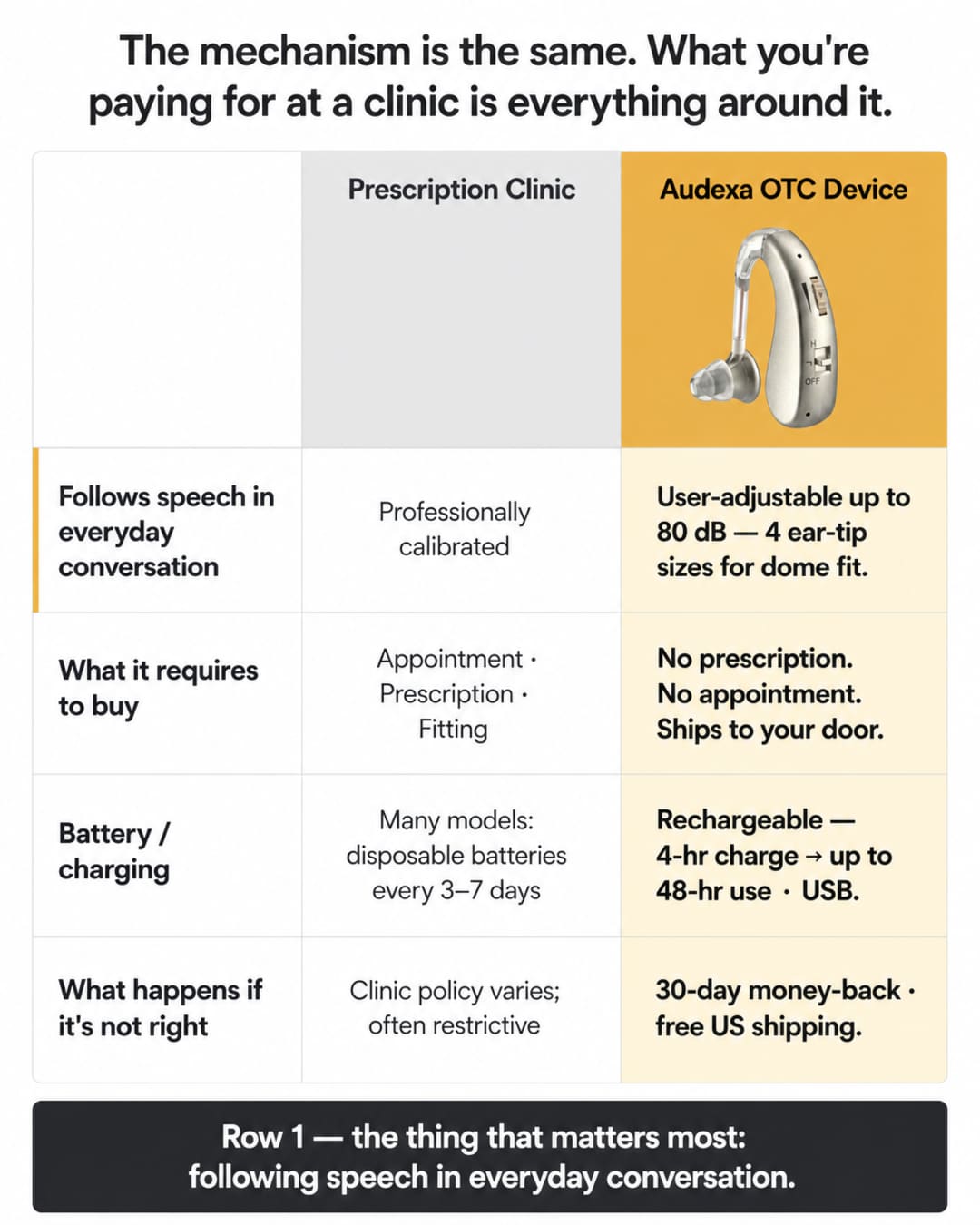
A behind-the-ear (BTE) rechargeable hearing device, set up at home by the user. No prescription. No appointment. No four-figure bill.
The device that fits this description — and the one this piece examines — is the Audexa hearing device, sold as a pair. Audexa is a behind-the-ear device. A small housing sits over the top of the ear; a thin acoustic tube routes amplified sound into a silicone dome seated in the ear canal. The volume is controlled by a single top-mounted dial — adjustable up to 80 dB — and an on/off switch on the front face. Four silicone ear-tip sizes are included in the box, specifically so the dome seats correctly inside the ear canal: a properly seated dome is what keeps the device stable during conversation and what reduces the feedback loop that causes the high-pitched squeal common in ill-fitting devices. The device charges via USB (wall outlet, power bank, or computer) — a full charge takes approximately four hours and delivers up to 48 hours of use. There are no disposable batteries to fumble, no weekly trip to the pharmacy for size 312s.
The simplicity is the point. One dial. One switch. Four ear-tip sizes to fit the ear. This is a device an adult with arthritic hands can operate and a device that works in a kitchen, at a dinner table, or on a phone call — the everyday speech situations where the "just forget it" problem actually lives.
3 Verification Steps — Before You Decide
Confirm the FDA Rule
Search "FDA OTC hearing aid rule October 2022." Confirm for yourself that purchasing a non-prescription hearing device is fully legal for adults 18+ with self-perceived mild-to-moderate difficulty.
Read the Return Terms Directly
Check Audexa's return policy on the product page. Look specifically for: return window in days, return-kit fee (should be none), restocking fee (should be none). A clean policy is in writing. If it isn't, that's information too.
Verify the Charge Claim on Day One
Note the charge cycle claim: up to 48 hours per charge from a 4-hour USB charge. This is a testable specification — verify it on day one, not day twenty-nine.
Who This Is For — And What People Notice First

Approximately 37.5 million American adults, roughly 15% of the population, report some degree of trouble hearing (NIDCD). Of those who could benefit from a hearing device, only about 1 in 4 actually uses one (HLAA). The gap is not primarily about severity. It is about access, cost, and — until 2022 — a legal and logistical framework that made purchasing a hearing device without a prescription effectively impossible for most people.
The practical verification of whether a device like Audexa delivers on its core function — making speech easier to follow — is available to anyone in the first week of use: a phone call, a dinner table, a conversation in a kitchen. The 30-day window exists because that is enough time to know.
What people report noticing first, in the accounts this category generates, is not dramatic. It is quiet. The keyboard they suddenly hear again. The grandchild on the phone whose voice comes through. The conversation at the table that they actually followed, start to finish, without filling in the blanks.
"She was able to hear her great-grandchild sing to her."
The device category Audexa belongs to is not a medical treatment. It is a direct-to-consumer amplification device, legal under the FDA OTC rule, designed to make everyday speech — at a table, on a phone, in a kitchen — easier to follow. That is its function. That is the claim. See the full breakdown on the next page →
The Question Most People Ask Before Committing — And How to Answer It Yourself
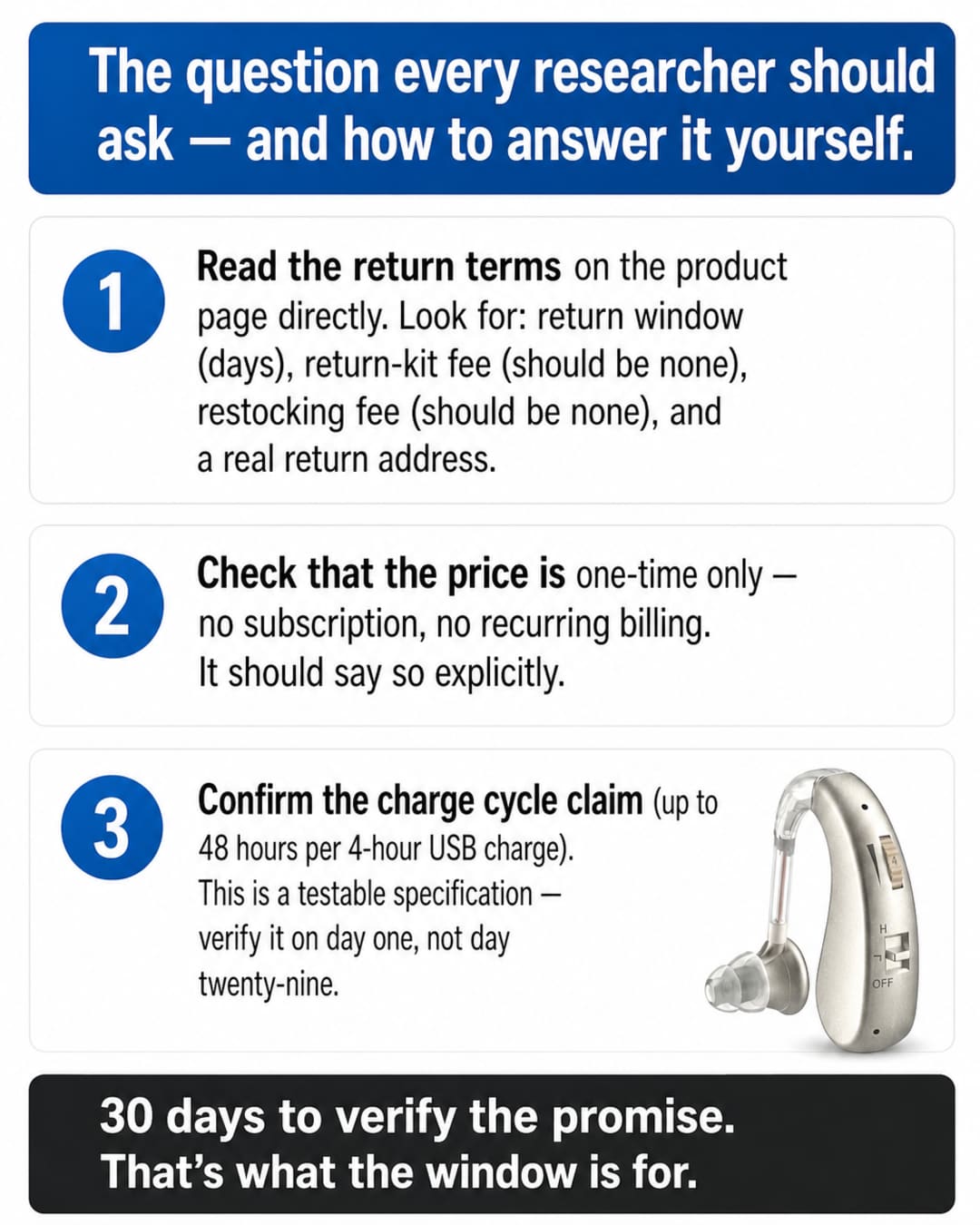
"How do I know this isn't the same as every other cheap hearing device I've seen — and that I can actually return it if it doesn't work?" It is the right question. The OTC hearing device category has a documented return problem. More than one brand in this space has been called out for return-kit fees, restocking charges, and phone numbers that lead nowhere. The Vermont Attorney General settled with one brand in February 2025 specifically over deceptive practices targeting seniors.
So the answer has to be visible and verifiable, not just stated. Audexa's stated policy: 30-day money-back return, free US shipping, no restocking fee. The verification step for this — before you buy — is to read the return terms on the product page directly. Look for the window, the fee structure, and the return address. If it's clean and in writing, that is your answer. If it isn't, that's also your answer.
The 30-day window is enough time to bring it to a family dinner. To make a phone call. To find out, in the situations that actually matter, whether it works for you. That's what the window is for.